By Jim Coleman
Universities sometimes try to explain away soaring college costs by claiming that the services they offer have fixed productivity levels. Because of these fixed productivity levels they are unable to become more efficient, so prices rise (in real terms) relative to many other goods. For example, lectures today are still more or less conducted in the same manner they were by Socrates in ancient Athens. That’s over 2,400 years without substantial productivity increase! The reality, however, is that college costs are soaring not because higher education genuinely has a fixed productivity level, but because colleges simply refused to innovate and serve the changing needs of their customers.
The success of Entrepreneur Burk Smith illustrates that there are plenty of productivity advances to be made in higher education if one is willing to seize them. Smith’s company, SmartThinking started offering alternatives to Universities’ traditional in-house tutoring in counseling services. SmarThinking.com offers a variety of tutoring to students at participating institutions, while InsideTrack.com provides counseling services to students to assist them in staying engaged and on track with their broader life goals. The results have been impressive. By utilizing the internet and moving away from the traditional labor structure of universities, Smith’s services have been able to provide higher quality at a lower price. Perhaps the most appealing aspect is the gains to the student. Not only does their company charge less, but they also have more convenient options. Tutors are available 24/7 on a variety of subjects; they can even turn in essays and receive a detailed critique back in less than 24 hours.
As reported in the chronicle, Smith recently took this concept to the next level by offering accreditated college courses through his newest venture, StraighterLine.com. Students can enroll in college courses for just $399 each. The courses are online so they can progress through the course when they want at the pace they want. There are significant economic gains from this arrangement. Students are offered cheaper more convenient courses, and colleges are able to free up resources; more classrooms will be available for other classes and labor that would have been used to teach intro or remedial courses can be shifted to a higher value use.
Smith’s success shows that there is clearly a demand for these services, and if the academy refuses to innovate, the market will be glad to do so. But first, obstacles in the form of federal regulations and accrediting agencies need to be reworked in order encourage more entrepreneurs to invest in higher education.
Wednesday, June 25, 2008


Tuesday, June 24, 2008
A picture "worth at least two thousand words"
by Andrew Gillen
There is a must read blog posting over at Growthology titled Jobs of the Future: The Answer.
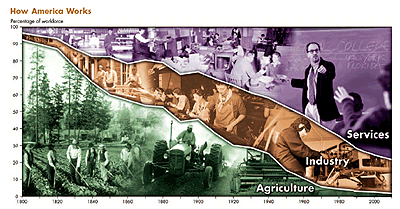
As he says, the following graph, borrowed from a 2003 report of the Dallas Fed shows the percent of the workforce employed in agriculture, industry, and services, is "worth at least two thousand words."
HT: Tim Kane
There is a must read blog posting over at Growthology titled Jobs of the Future: The Answer.
As he says, the following graph, borrowed from a 2003 report of the Dallas Fed shows the percent of the workforce employed in agriculture, industry, and services, is "worth at least two thousand words."

HT: Tim Kane
Tennessee Trims the Fat
By Jim Coleman
I was pleasantly surprised to read an article today stating that the Tennessee board of regents has embraced some economic reasoning. The reagents plan to begin cutting university programs that turn out few graduates. Vice chancellor Myrick Short explained, "Campuses shouldn't be carrying programs that are not productive, putting resources into them that they could be putting into programs that are needed by the state,"
Mr. Short is right. Not only are underutilized programs costly in terms of dollars, they are also costly in terms of opportunity cost. When universities insist on maintaining marginal programs, they must implicitly give up the chance to use those resources in some more productive way. What sense does it make for universities to host programs that only turn out 1 or 2 grads a year, when a much higher return on investment can be made by moving those funds elsewhere?
Eliminating low producing and redundant programs (particularly at the graduate level where cost per student is highest) is a great way to make universities more productive. However, it is a change that is unlikely to come from the universities themselves. Universities love prestige and like to brag about their exotic undergraduate programs or graduate offerings. To effectively trim the dead weight by cutting programs requires a change in university incentives.
This can be done heavy-handedly, by some central authority, such as in Tennessee’s case, or it can be done in a more gentle fashion by simply making universities directly bear more of the cost of maintaining these programs. If the state refuses to bail out a university which is hemorrhaging money from a program that only produces two M.A.s a year, the school has a strong financial incentive to reevaluate the program and see if those funds can create more value elsewhere.
Ultimately, cutting marginal programs results in a more affordable, higher value education for the students and a decreased tax burden for the public. Let’s hope that in the future eliminating wasteful programs becomes less newsworthy and just business as usual.
I was pleasantly surprised to read an article today stating that the Tennessee board of regents has embraced some economic reasoning. The reagents plan to begin cutting university programs that turn out few graduates. Vice chancellor Myrick Short explained, "Campuses shouldn't be carrying programs that are not productive, putting resources into them that they could be putting into programs that are needed by the state,"
Mr. Short is right. Not only are underutilized programs costly in terms of dollars, they are also costly in terms of opportunity cost. When universities insist on maintaining marginal programs, they must implicitly give up the chance to use those resources in some more productive way. What sense does it make for universities to host programs that only turn out 1 or 2 grads a year, when a much higher return on investment can be made by moving those funds elsewhere?
Eliminating low producing and redundant programs (particularly at the graduate level where cost per student is highest) is a great way to make universities more productive. However, it is a change that is unlikely to come from the universities themselves. Universities love prestige and like to brag about their exotic undergraduate programs or graduate offerings. To effectively trim the dead weight by cutting programs requires a change in university incentives.
This can be done heavy-handedly, by some central authority, such as in Tennessee’s case, or it can be done in a more gentle fashion by simply making universities directly bear more of the cost of maintaining these programs. If the state refuses to bail out a university which is hemorrhaging money from a program that only produces two M.A.s a year, the school has a strong financial incentive to reevaluate the program and see if those funds can create more value elsewhere.
Ultimately, cutting marginal programs results in a more affordable, higher value education for the students and a decreased tax burden for the public. Let’s hope that in the future eliminating wasteful programs becomes less newsworthy and just business as usual.
Monday, June 23, 2008
Universities Should follow NWU's Lead
By Jim Coleman
Last Friday Northwestern University officially announced that it will be offering a fast-track JD. Students will still complete the standard three year curriculum but will do so in two-thirds of the time. This raises the question: if one of the nation’s top law schools can reduce the time it takes to get a law degree by a third, why can’t more undergraduate programs cut the time it take to get a bachelor’s by a fourth? A three years bachelors would both increase college accessibility and lower costs to the students. More people could attend college because universities would be moving students through faster. Students would reap tremendous financial benefits, not only would they be paying for one less year, they would also be earning a salary a year earlier. For those not locked away in the ivory tower, a 3-year bachelor’s is a no brainer.
So, if it’s such a no brainer, why hasn’t it been done? There are two reasons. First, there are perverse financial incentives at work. The government is in the habit of showering money on universities, and the amount of money doled out is linked to the number of students at an institution. Consequently, universities don’t want students to graduate too quickly as that could compromise their future revenue stream. Moreover, students themselves have incentives not to graduate early. The government makes highly subsidized loans available to students, which they don’t have to pay back until after graduation. As a result students have less of an incentive to move on when they can stay in college and party for an extra year, while you the taxpayer cover their loans.
Second, accreditors make it difficult to institutionalize accelerated degree programs. For example, up until 2004 the American Bar Association prohibited any law degree being completed in less than 6 semesters. Such is the case with regional accreditors at the undergraduate level. These accreditors hold regional cartels and are run by the top brass of the universities in that area (the very people they are supposed to be regulating). The accreditors remark that universities must allow “sufficient time” for a proper education and “conform to commonly accepted standards” in higher education. One can see that the vague nature of these statements allow accreditors to twist them to suite their own self-interest. Accreditation commissioners have an incentive to discourage three- year bachelor’s in order maximize revenue at their own institutions as well as to stop competing institutions from offering fast-track programs.
Incentives matter. And it’s unlikely that that we will see wide spread 3-year bachelor programs until financial incentives are changed so as to not reward students and universities for dragging out undergraduate education. Furthermore, the regional accreditation cartels must be broken so that institutions have incentives to openly compete with another in offering fast-track degrees.
Last Friday Northwestern University officially announced that it will be offering a fast-track JD. Students will still complete the standard three year curriculum but will do so in two-thirds of the time. This raises the question: if one of the nation’s top law schools can reduce the time it takes to get a law degree by a third, why can’t more undergraduate programs cut the time it take to get a bachelor’s by a fourth? A three years bachelors would both increase college accessibility and lower costs to the students. More people could attend college because universities would be moving students through faster. Students would reap tremendous financial benefits, not only would they be paying for one less year, they would also be earning a salary a year earlier. For those not locked away in the ivory tower, a 3-year bachelor’s is a no brainer.
So, if it’s such a no brainer, why hasn’t it been done? There are two reasons. First, there are perverse financial incentives at work. The government is in the habit of showering money on universities, and the amount of money doled out is linked to the number of students at an institution. Consequently, universities don’t want students to graduate too quickly as that could compromise their future revenue stream. Moreover, students themselves have incentives not to graduate early. The government makes highly subsidized loans available to students, which they don’t have to pay back until after graduation. As a result students have less of an incentive to move on when they can stay in college and party for an extra year, while you the taxpayer cover their loans.
Second, accreditors make it difficult to institutionalize accelerated degree programs. For example, up until 2004 the American Bar Association prohibited any law degree being completed in less than 6 semesters. Such is the case with regional accreditors at the undergraduate level. These accreditors hold regional cartels and are run by the top brass of the universities in that area (the very people they are supposed to be regulating). The accreditors remark that universities must allow “sufficient time” for a proper education and “conform to commonly accepted standards” in higher education. One can see that the vague nature of these statements allow accreditors to twist them to suite their own self-interest. Accreditation commissioners have an incentive to discourage three- year bachelor’s in order maximize revenue at their own institutions as well as to stop competing institutions from offering fast-track programs.
Incentives matter. And it’s unlikely that that we will see wide spread 3-year bachelor programs until financial incentives are changed so as to not reward students and universities for dragging out undergraduate education. Furthermore, the regional accreditation cartels must be broken so that institutions have incentives to openly compete with another in offering fast-track degrees.
Thursday, June 19, 2008
Incorrect Assumption
by Andrew Gillen
A blog posting over at "Economists for Obama" caught my eye. It concludes, that a new tuition tax credit would mainly affect enrollment, and that "the effect of the credit on tuition would be small."
Given the assumptions made, the analysis is correct. However, the assumptions are incorrect.
(I apologize in advance for the econ jargon) It assumes that the supply curve is elastic because "schools can always squeeze in a few extra students." While I don't doubt that any given school could squeeze in a few more students, a "few more" is not enough to make the supply curve elastic. In fact, in the short term, schools run into capacity constraints quickly, and in the long term, there are significant barriers to entry (i.e. start-up costs, accreditation) and it is not in many of their interests to expand enrollments (see the section "Why Subsidies for Higher Education Do Not Have the Same Effect as Other Subsidies" in our study on the Tuition Bubble for a detailed explanation).
What this means is that the supply curve is inelastic, not elastic. This is consistent with the findings of a new NBER paper by Susan Dynarski and Judith E. Scott-Clayton which finds "little compelling evidence" that increases in student aid are effective in increasing enrollment.
Bottom line: The graph they show with the correct supply curve (inelastic instead of elastic) would indicate that it would be primarily tuition, not enrollments, that would go up.
HT: Mark Thoma
A blog posting over at "Economists for Obama" caught my eye. It concludes, that a new tuition tax credit would mainly affect enrollment, and that "the effect of the credit on tuition would be small."
Given the assumptions made, the analysis is correct. However, the assumptions are incorrect.
(I apologize in advance for the econ jargon) It assumes that the supply curve is elastic because "schools can always squeeze in a few extra students." While I don't doubt that any given school could squeeze in a few more students, a "few more" is not enough to make the supply curve elastic. In fact, in the short term, schools run into capacity constraints quickly, and in the long term, there are significant barriers to entry (i.e. start-up costs, accreditation) and it is not in many of their interests to expand enrollments (see the section "Why Subsidies for Higher Education Do Not Have the Same Effect as Other Subsidies" in our study on the Tuition Bubble for a detailed explanation).
What this means is that the supply curve is inelastic, not elastic. This is consistent with the findings of a new NBER paper by Susan Dynarski and Judith E. Scott-Clayton which finds "little compelling evidence" that increases in student aid are effective in increasing enrollment.
Bottom line: The graph they show with the correct supply curve (inelastic instead of elastic) would indicate that it would be primarily tuition, not enrollments, that would go up.
HT: Mark Thoma
Will the NCAA Get Serious?
By Richard Vedder
The NCAA has popped up a lot lately on my radar screen. News accounts talk about the cycles in NCCA enforcement of infractions, with coaches trying to get the organization to ease up, while critics are demanding tougher crack downs on rules violators. And then I get an invitation from, of all persons, the President, to a reception on the White House Lawn for championship NCAA teams in several minor sports.
I am two minds about intercollegiate athletics. The one side of me says, "let's recognize that this is professional sports and that we should treat athletes accordingly, namely paying them wages according to their marginal contribution to team revenues." That side of me says we are exploiting students financially, with the gains going to coaches and others in the academic community. If we can have million dollar coaches, we can have million dollar athletes as well. The notion that these are "students" who play basketball on the side while attending school is a fiction in the top Division I schools, and let us recognize that.
The second side of me says, "let us really reform the system." We cannot get all the commercial dimensions out, but we can put big restraints on the length of seasons and on the expeected academic performance of athletes. We can limit red-shirting and other nefarious practices,cut football teams to 60 or so, prohibit freshman from playing, or a host of other innovations. We can return sports to the way they were in 1950 --competitive, popular amongst fans, fun --but some recognition of the fact that college is first and foremost an academic adventure, not a sports one.
I am going to see the President honor, for example, the University of Tennessee's woman golf team. I suspect a majority of those gals do consider the academic mission moderately seriously, and are not looking at college golf as a ticket to future athletic success as a pro. The same is true of bowling,gymnastics, fencing, wrestling and a host of other minor sports. I am not against sports --au contraire, I think competitive athletics builds character, leadership skills, etc. But things need to be put in proper perspective and the current status quo is far from optimal.
The NCAA has popped up a lot lately on my radar screen. News accounts talk about the cycles in NCCA enforcement of infractions, with coaches trying to get the organization to ease up, while critics are demanding tougher crack downs on rules violators. And then I get an invitation from, of all persons, the President, to a reception on the White House Lawn for championship NCAA teams in several minor sports.
I am two minds about intercollegiate athletics. The one side of me says, "let's recognize that this is professional sports and that we should treat athletes accordingly, namely paying them wages according to their marginal contribution to team revenues." That side of me says we are exploiting students financially, with the gains going to coaches and others in the academic community. If we can have million dollar coaches, we can have million dollar athletes as well. The notion that these are "students" who play basketball on the side while attending school is a fiction in the top Division I schools, and let us recognize that.
The second side of me says, "let us really reform the system." We cannot get all the commercial dimensions out, but we can put big restraints on the length of seasons and on the expeected academic performance of athletes. We can limit red-shirting and other nefarious practices,cut football teams to 60 or so, prohibit freshman from playing, or a host of other innovations. We can return sports to the way they were in 1950 --competitive, popular amongst fans, fun --but some recognition of the fact that college is first and foremost an academic adventure, not a sports one.
I am going to see the President honor, for example, the University of Tennessee's woman golf team. I suspect a majority of those gals do consider the academic mission moderately seriously, and are not looking at college golf as a ticket to future athletic success as a pro. The same is true of bowling,gymnastics, fencing, wrestling and a host of other minor sports. I am not against sports --au contraire, I think competitive athletics builds character, leadership skills, etc. But things need to be put in proper perspective and the current status quo is far from optimal.
Wednesday, June 18, 2008
The Next "Logical Step"
By Andrew Gillen
The NY Times reports today that new legislation has been introduced that some are billing as the next "logical step" to solve the student loan crisis.
For those of you who missed it, Congress lowered the fees and interest rates that private lenders can charge for federally backed student loans. Unfortunately for Congress, they did this in the midst of the credit crunch when capital was already becoming scarce, raising the costs to lenders of providing loans. Unsurprisingly, higher costs and lower benefits have combined to make the private loan market unattractive. Lenders have been pulling out of the loan programs, and those that remain have been dropping "high risk" schools.
That's where the new legislation comes in. It will ensure that "lenders that participate in the federal loan program would have to extend credit to any eligible student" so as to ensure access. In reality, what this will do is push even more lenders out of the market, which would require more borrowing directly from the federal government. A terrific WSJ editorial made a note about previous proposals that still sums up Congress's actions:
Even if there are private lenders that survive this, they will be private in name only. In what sense is a business that has its prices fixed, and customers selected by the government "private?"** If the goal is to outlaw private lending (and that is the only way in which I can see this being a "logical step") then just do it outright. The virtues of private vs. public lending would be a useful debate to have. But this piecemeal attack on private lenders to drive them out of the market (this may or may not be the goal, but it will be the effect) is sneaky and underhanded.
** I can think of only one other type of "private" business that has prices and customers selected by the government, and that is utilities. But utilities are regulated to prevent the market power that would arise from economies of scale. What market failure is all this legislation supposedly addressing?
The NY Times reports today that new legislation has been introduced that some are billing as the next "logical step" to solve the student loan crisis.
For those of you who missed it, Congress lowered the fees and interest rates that private lenders can charge for federally backed student loans. Unfortunately for Congress, they did this in the midst of the credit crunch when capital was already becoming scarce, raising the costs to lenders of providing loans. Unsurprisingly, higher costs and lower benefits have combined to make the private loan market unattractive. Lenders have been pulling out of the loan programs, and those that remain have been dropping "high risk" schools.
That's where the new legislation comes in. It will ensure that "lenders that participate in the federal loan program would have to extend credit to any eligible student" so as to ensure access. In reality, what this will do is push even more lenders out of the market, which would require more borrowing directly from the federal government. A terrific WSJ editorial made a note about previous proposals that still sums up Congress's actions:
Congress mandated a return on student loans that is too low to attract private capital in the current market... [So now] Taxpayers will bear more risk so that Congress can fashion a new business model to replace the one it just destroyed.
Even if there are private lenders that survive this, they will be private in name only. In what sense is a business that has its prices fixed, and customers selected by the government "private?"** If the goal is to outlaw private lending (and that is the only way in which I can see this being a "logical step") then just do it outright. The virtues of private vs. public lending would be a useful debate to have. But this piecemeal attack on private lenders to drive them out of the market (this may or may not be the goal, but it will be the effect) is sneaky and underhanded.
** I can think of only one other type of "private" business that has prices and customers selected by the government, and that is utilities. But utilities are regulated to prevent the market power that would arise from economies of scale. What market failure is all this legislation supposedly addressing?
Borrowing to Party
By Richard Vedder
Data that I have come across in the past few days or months suggest the following:
1) The proportion of college freshmen working at a job while in college is lower today than at any time in the past 30 years (Bureau of Labor Statistics);
2) The amount of time that the typical student spends on academic matters --attending class, studying, writing papers, etc. --is embarrassingly low, under 40 hours a week for a 32 week year (National Survey of Student Engagement or NSSE);
3) The amount of time the typical student spends on entertainment, bar-hopping, watching television, etc., is much higher than for the working adult population (NSSE);
4) Students are borrowing record amounts of money to go to college; the typical student probably has a sizable NEGATIVE net worth --lower wealth than, say, the students of 30 years ago despite an overall substantial rise in national wealth (College Board, other sources).
Put bluntly, students are borrowing heavily to party --at least relative to past generations of students. As academic standards decline with grade inflation and increasing numbers of mediocre students attend college, the costs of college have soared. But instead of working at jobs more to pay their way through school, kids are simply borrowing to cover the rising costs --and a bit more so they can work less at jobs (not to mention in school).
In short, we are spoiling our children and encouraging them onto a path of fiscal irresponsibility. The government student loan program gets a good bit of the blame, as do the colleges for allowing standards to slip, and politicians for ignoring the problem and calling for greater college participation. It is no wonder that I continually get negative relationships between government higher education spending and economic growth ---we are subsidizing an adolescent leisure class more than "investing in human capital."
Data that I have come across in the past few days or months suggest the following:
1) The proportion of college freshmen working at a job while in college is lower today than at any time in the past 30 years (Bureau of Labor Statistics);
2) The amount of time that the typical student spends on academic matters --attending class, studying, writing papers, etc. --is embarrassingly low, under 40 hours a week for a 32 week year (National Survey of Student Engagement or NSSE);
3) The amount of time the typical student spends on entertainment, bar-hopping, watching television, etc., is much higher than for the working adult population (NSSE);
4) Students are borrowing record amounts of money to go to college; the typical student probably has a sizable NEGATIVE net worth --lower wealth than, say, the students of 30 years ago despite an overall substantial rise in national wealth (College Board, other sources).
Put bluntly, students are borrowing heavily to party --at least relative to past generations of students. As academic standards decline with grade inflation and increasing numbers of mediocre students attend college, the costs of college have soared. But instead of working at jobs more to pay their way through school, kids are simply borrowing to cover the rising costs --and a bit more so they can work less at jobs (not to mention in school).
In short, we are spoiling our children and encouraging them onto a path of fiscal irresponsibility. The government student loan program gets a good bit of the blame, as do the colleges for allowing standards to slip, and politicians for ignoring the problem and calling for greater college participation. It is no wonder that I continually get negative relationships between government higher education spending and economic growth ---we are subsidizing an adolescent leisure class more than "investing in human capital."
Friday, June 13, 2008
Why do some schools graduate more students than others?
By Richard Vedder and Matthew Denhart
We have been looking at variations in the four year graduation rate of well over 500 schools, trying to explain variations between them. Why do some schools graduate 80 percent of their students or more in four years --while others graduate just 30 percent? As in many other things, conventional wisdom is often just plain wrong.
MORE GENEROUS FINANCIAL AID INCREASES GRADUATION RATES
Conventional wisdom is that economic worries are a big cause of college dropping out, and when schools up financial aid to students, it should improve the prospects of graduation. Our results show the opposite --increases in financial aid are negatively related to graduation rates --in a statistically significant way. More financial aid means lower costs to students, incentivizing them to stick around college longer. So much for conventional wisdom. To be sure, there are some measurement and other issues, so the findings are not absolutely iron-clad, but they are still revealing.
SAT SCORES ARE NOT NEEDED, BECAUSE THEY ARE A POOR INDICATOR OF COLLEGE PERFORMANCE
Total balderdash. The relationship between SAT scores and graduation rates is extremely strong --a 100 point rise in the composite SAT (verbal and math) increases the portion getting their degree by nearly 10 percentage points --say from 40 to 50 percent. Which makes us shake our heads as we hear about schools dropping the SAT exam as a requirement for admission.
PRIVATE SCHOOLS HAVE HIGHER GRADUATION RATES BECAUSE THEY GET BETTER STUDENTS
While private schools do get better students (as measured by SAT scores), and that does improve graduation rates, they also have graduation rates even higher than one would predict after controlling for SAT scores, the racial composition of the student body, the percentage of students receiving financial aid, the proportion of faculty with tenure, and other factors. Why? We are not certain but the public-private differential, even after controlling for these other factors, is still huge. It is worthy of further investigation.
HAVING MORE TENURE TRACK FACULTY MEANS BETTER GRADUATION RATES
Here is one where we get statistical results consistent with conventional wisdom. A large portion of adjunct, non-tenured faculty is correlated with lower graduation rates, other factors equal. Having more people with a long term institutional commitment does seem to make a difference in terms of student outcomes, consistent with several other studies.
HISTORICALLY BLACK COLLEGES HAVE LOW GRADUATION RATES
After controlling for other factors (e.g., SAT scores, financial aid), we find graduation rates are much HIGHER in historically black institutions. There are multiple interpretations that can be placed on that. A negative one is that historically black schools have lower standards of rigor and some students who would drop out of other schools persist in the black institutions. A positive interpretation is that African-American students have fewer frustrations, face less discrimination, and feel less neglected at the black institutions, stimulating performance (by the same token, students grouped by religious affiliation might also be expected to do well, although we have not tested that hypothesis).
Our work is not the last word, but it is based on vast data and a reasonable statistical model. It does make us urge caution in accepting everything you have been told about the determinants of dropping out.
Richard Vedder directs the Center for College Affordability and Productivity, is a Visiting Scholar at the American Enterprise Institute and teaches at Ohio University. Matthew Denhart is an honors political science student at Ohio University.
We have been looking at variations in the four year graduation rate of well over 500 schools, trying to explain variations between them. Why do some schools graduate 80 percent of their students or more in four years --while others graduate just 30 percent? As in many other things, conventional wisdom is often just plain wrong.
MORE GENEROUS FINANCIAL AID INCREASES GRADUATION RATES
Conventional wisdom is that economic worries are a big cause of college dropping out, and when schools up financial aid to students, it should improve the prospects of graduation. Our results show the opposite --increases in financial aid are negatively related to graduation rates --in a statistically significant way. More financial aid means lower costs to students, incentivizing them to stick around college longer. So much for conventional wisdom. To be sure, there are some measurement and other issues, so the findings are not absolutely iron-clad, but they are still revealing.
SAT SCORES ARE NOT NEEDED, BECAUSE THEY ARE A POOR INDICATOR OF COLLEGE PERFORMANCE
Total balderdash. The relationship between SAT scores and graduation rates is extremely strong --a 100 point rise in the composite SAT (verbal and math) increases the portion getting their degree by nearly 10 percentage points --say from 40 to 50 percent. Which makes us shake our heads as we hear about schools dropping the SAT exam as a requirement for admission.
PRIVATE SCHOOLS HAVE HIGHER GRADUATION RATES BECAUSE THEY GET BETTER STUDENTS
While private schools do get better students (as measured by SAT scores), and that does improve graduation rates, they also have graduation rates even higher than one would predict after controlling for SAT scores, the racial composition of the student body, the percentage of students receiving financial aid, the proportion of faculty with tenure, and other factors. Why? We are not certain but the public-private differential, even after controlling for these other factors, is still huge. It is worthy of further investigation.
HAVING MORE TENURE TRACK FACULTY MEANS BETTER GRADUATION RATES
Here is one where we get statistical results consistent with conventional wisdom. A large portion of adjunct, non-tenured faculty is correlated with lower graduation rates, other factors equal. Having more people with a long term institutional commitment does seem to make a difference in terms of student outcomes, consistent with several other studies.
HISTORICALLY BLACK COLLEGES HAVE LOW GRADUATION RATES
After controlling for other factors (e.g., SAT scores, financial aid), we find graduation rates are much HIGHER in historically black institutions. There are multiple interpretations that can be placed on that. A negative one is that historically black schools have lower standards of rigor and some students who would drop out of other schools persist in the black institutions. A positive interpretation is that African-American students have fewer frustrations, face less discrimination, and feel less neglected at the black institutions, stimulating performance (by the same token, students grouped by religious affiliation might also be expected to do well, although we have not tested that hypothesis).
Our work is not the last word, but it is based on vast data and a reasonable statistical model. It does make us urge caution in accepting everything you have been told about the determinants of dropping out.
Richard Vedder directs the Center for College Affordability and Productivity, is a Visiting Scholar at the American Enterprise Institute and teaches at Ohio University. Matthew Denhart is an honors political science student at Ohio University.
Thursday, June 12, 2008
Academic Malpractices --a Continuing Saga
By Richard Vedder
Asians at Princeton
A couple stories in INSIDE HIGHER ED the last couple of days caught my attention. The Department of Education is looking broadly at Princeton's policies with respect to the admission of Asian students. Discrimination has been alleged.
Anyone who has read the masterful books written by Jerome Karabel (The Chosen) or Daniel Golden (The Price of Admission) would not be surprised by the Education Department's inquiry. For decades, the Ivies have been using subjective concepts to evaluate things like "character" or "leadership" and then have used this as a means to admit favored groups and nix less favored ones. Early in the last century, Jews were restricted and discriminated against. Private school kids were favored over public school ones. Alumni children are typically favored, and Asians are not, as anyone who read Golden's account of Henry Park knows. Henry was the excellent graduate of Groton School with a 1560 combined SAT score who was turned down by many Ivies while African-American students with far poorer academic records were accepted. As Henry's mom succinctly summarized it, "I was naive...I thought college admissions had something to do with academics."
Why are the Ivies demonstrably anti-Asian (even though, in fairness, they do accept a lot of Asian students)? I think it is all about politics. The alums have influence and big pocketbooks. African Americans, especially, and Hispanics (to a lesser extent) have powerful political forces interested in their welfare. But Asians largely eschew politics, including university/admission office politics. They raise less of a fuss when dumped on. However, it is morally dubious, and also somewhat anti-academic and anti-intellectual (although the kids accepted are almost universally very good students). In any case, I think a rigorous academic standard should be the criterion used --arguably the SOLE criteria used --in admitting students. Any other standard opens schools up to claims of bias and discrimination. The objective academic standard works in Europe, where even the Prime Minister's child was rejected at Oxford. This country is built on meritocracy not aristocracy; why cannot we use the same objective standards?
***************
This is not a good week for the Ivy League. Leaving Princeton and moving up north to Harvard, it turns out that a prominent professor has been taking large consulting monies from a pharmaceutical firm and not reporting it --as required by Harvard and federal law. This reminds me of a similar scandal a few years back, when an economics professor buddy of then President Laurence Summers was found to have misused millions of grant monies relating to Russia. What happened? Harvard forked over millions, and the professor continues to teach and hobnob with Summers. Where is the accountability? Are college folks immune from the consequences of dubious behavior that anywhere else in society would be severely punished? Where is the transparency? Is there any wonder Senator Chuck Grassley (whose staff uncovered this latest scam) is on the warpath? Harvard may still discipline the professor in question, but don't count on it.
Asians at Princeton
A couple stories in INSIDE HIGHER ED the last couple of days caught my attention. The Department of Education is looking broadly at Princeton's policies with respect to the admission of Asian students. Discrimination has been alleged.
Anyone who has read the masterful books written by Jerome Karabel (The Chosen) or Daniel Golden (The Price of Admission) would not be surprised by the Education Department's inquiry. For decades, the Ivies have been using subjective concepts to evaluate things like "character" or "leadership" and then have used this as a means to admit favored groups and nix less favored ones. Early in the last century, Jews were restricted and discriminated against. Private school kids were favored over public school ones. Alumni children are typically favored, and Asians are not, as anyone who read Golden's account of Henry Park knows. Henry was the excellent graduate of Groton School with a 1560 combined SAT score who was turned down by many Ivies while African-American students with far poorer academic records were accepted. As Henry's mom succinctly summarized it, "I was naive...I thought college admissions had something to do with academics."
Why are the Ivies demonstrably anti-Asian (even though, in fairness, they do accept a lot of Asian students)? I think it is all about politics. The alums have influence and big pocketbooks. African Americans, especially, and Hispanics (to a lesser extent) have powerful political forces interested in their welfare. But Asians largely eschew politics, including university/admission office politics. They raise less of a fuss when dumped on. However, it is morally dubious, and also somewhat anti-academic and anti-intellectual (although the kids accepted are almost universally very good students). In any case, I think a rigorous academic standard should be the criterion used --arguably the SOLE criteria used --in admitting students. Any other standard opens schools up to claims of bias and discrimination. The objective academic standard works in Europe, where even the Prime Minister's child was rejected at Oxford. This country is built on meritocracy not aristocracy; why cannot we use the same objective standards?
***************
This is not a good week for the Ivy League. Leaving Princeton and moving up north to Harvard, it turns out that a prominent professor has been taking large consulting monies from a pharmaceutical firm and not reporting it --as required by Harvard and federal law. This reminds me of a similar scandal a few years back, when an economics professor buddy of then President Laurence Summers was found to have misused millions of grant monies relating to Russia. What happened? Harvard forked over millions, and the professor continues to teach and hobnob with Summers. Where is the accountability? Are college folks immune from the consequences of dubious behavior that anywhere else in society would be severely punished? Where is the transparency? Is there any wonder Senator Chuck Grassley (whose staff uncovered this latest scam) is on the warpath? Harvard may still discipline the professor in question, but don't count on it.
Tuesday, June 10, 2008
Examining the National Purposes of Higher Education
By Richard Vedder
The title on this blog is the title of a conference that took place, I believe yesterday, at the University of Virginia, put on by several groups (e.g., Lumina Foundation, Association of Governing Boards). If Doug Lederman's report in INSIDE HIGHER ED is accurate (and I find it always is), the single most important message to the assembled group of educational leaders was: we need more people to go to college. Employers are clamoring for more college educated kids, or so we read.
I hate to be the skunk at this higher education love fest (actually I wasn't invited --surprise, surprise), but the evidence I read is deepening my conviction that in some respects we are overinvested in higher education --too many kids are going to school. Several retired academics --Jackson Toby and Harry Stilles come immediately to mind --have been saying that for years. We push the need for increased enrollments at the same time we face very high attrition rates among existing enrollees, although I am the first to admit that data limitations make those rates somewhat suspect, especially as they relate to community colleges.
Thomas Ruchti and I have been exploring this issue a bit. We have asked the question: what has happened to educational attainment to workers in very low skilled occupations that clearly do not require a college degree for any reason relating to their productivity as workers --dishwashers, maids, etc.?
We are still in the process of gathering the data, but we see a steady rise in the proportion of lower skilled workers with some college, often with degrees. Now, I have nothing against highly educated persons doing lower skilled work if they so choose (my wife, who has a Ph.D., once worked, albeit for a short time, in a department store as a salesperson). But I do object to diverting significant public (taxpayer) resources to fund such things when the taxpayers themselves have better use of the money or where there are alternative better public uses for the funds.
The game is this: "we are moving to a more knowledge based economy, so nearly everyone should go to college," or so says the Educational Establishment. Then, the legislators appropriate more money. Then colleges take that money --and use it on virtually everything but expanding access. The University of Virginia, where the conference was held, has vastly more resources than a generation ago, including a multi-billion dollar endowment -- but precious few more students. It makes headlines when Yale announces it is going to expand enrollment by 15 percent, but not when Apple announces it is going to expand iPod or iPhone production by similar amounts. Supply expansion in business is ordinary, normal, the way things are done. In higher education, it is big news.
So in the name of access, the colleges are appealing for more money. They are deceptively using a dubious argument (given the attrition rates and growing number of vastly overqualified workers) to get funds which will then be diverted for other purposes --bait and switch. Shame.
The title on this blog is the title of a conference that took place, I believe yesterday, at the University of Virginia, put on by several groups (e.g., Lumina Foundation, Association of Governing Boards). If Doug Lederman's report in INSIDE HIGHER ED is accurate (and I find it always is), the single most important message to the assembled group of educational leaders was: we need more people to go to college. Employers are clamoring for more college educated kids, or so we read.
I hate to be the skunk at this higher education love fest (actually I wasn't invited --surprise, surprise), but the evidence I read is deepening my conviction that in some respects we are overinvested in higher education --too many kids are going to school. Several retired academics --Jackson Toby and Harry Stilles come immediately to mind --have been saying that for years. We push the need for increased enrollments at the same time we face very high attrition rates among existing enrollees, although I am the first to admit that data limitations make those rates somewhat suspect, especially as they relate to community colleges.
Thomas Ruchti and I have been exploring this issue a bit. We have asked the question: what has happened to educational attainment to workers in very low skilled occupations that clearly do not require a college degree for any reason relating to their productivity as workers --dishwashers, maids, etc.?
We are still in the process of gathering the data, but we see a steady rise in the proportion of lower skilled workers with some college, often with degrees. Now, I have nothing against highly educated persons doing lower skilled work if they so choose (my wife, who has a Ph.D., once worked, albeit for a short time, in a department store as a salesperson). But I do object to diverting significant public (taxpayer) resources to fund such things when the taxpayers themselves have better use of the money or where there are alternative better public uses for the funds.
The game is this: "we are moving to a more knowledge based economy, so nearly everyone should go to college," or so says the Educational Establishment. Then, the legislators appropriate more money. Then colleges take that money --and use it on virtually everything but expanding access. The University of Virginia, where the conference was held, has vastly more resources than a generation ago, including a multi-billion dollar endowment -- but precious few more students. It makes headlines when Yale announces it is going to expand enrollment by 15 percent, but not when Apple announces it is going to expand iPod or iPhone production by similar amounts. Supply expansion in business is ordinary, normal, the way things are done. In higher education, it is big news.
So in the name of access, the colleges are appealing for more money. They are deceptively using a dubious argument (given the attrition rates and growing number of vastly overqualified workers) to get funds which will then be diverted for other purposes --bait and switch. Shame.
Sunday, June 08, 2008
Yale Is Listening
By Richard Vedder
A few months ago, I had an op-ed in the Washington Post entitled "It's A Start Yale. Now Do Something Serious," referring to Yale's decision to increase financial aid for a large portion of its students. In the article, I mentioned the possibility of increasing supply --expanding enrollments or opening new campuses.
Yale is apparently listening. It has announced it will open two new residential undergraduate colleges and expand undergraduate enrollment by around 800 students, or 15 percent. The move is vastly overdue, but is welcomed nonetheless. Colleges have viewed restricted admissions as a virtue --a means of raising prestige. Education is the only business I know where success is obtained by turning customers away and snubbing them. Yet Yale is already about as prestigious as you can get, and its per student endowment is about even with that at Princeton and Harvard at a near obscene two million dollars per student ($100,000 a year). The much discussed increase in student aid absorbed only EIGHT percent of the new spending out of endowment funds associated with Yale's decision to spend five percent of endowment principal annually. This will absorb some more, and appropriately so.
I decry federal intervention into almost anything, but I must say that the threat of federal legislation often brings religion, virtue and common sense to some university leaders. Senator Grassley's fight for higher spending from endowment may be having further payoffs. The Ivy League alone cannot increase the supply of places enough to meet the insatiable demand of Americans for quality higher education, but it can set an example, leading maybe Stanford to start a Stanford U in the South, or Princeton a university in Arizona.
If the Mayo Clinic, Cleveland Clinic and other great, prestigious medical institutions can open up major satellite operations in places like Florida, why cannot universities do the same?
A few months ago, I had an op-ed in the Washington Post entitled "It's A Start Yale. Now Do Something Serious," referring to Yale's decision to increase financial aid for a large portion of its students. In the article, I mentioned the possibility of increasing supply --expanding enrollments or opening new campuses.
Yale is apparently listening. It has announced it will open two new residential undergraduate colleges and expand undergraduate enrollment by around 800 students, or 15 percent. The move is vastly overdue, but is welcomed nonetheless. Colleges have viewed restricted admissions as a virtue --a means of raising prestige. Education is the only business I know where success is obtained by turning customers away and snubbing them. Yet Yale is already about as prestigious as you can get, and its per student endowment is about even with that at Princeton and Harvard at a near obscene two million dollars per student ($100,000 a year). The much discussed increase in student aid absorbed only EIGHT percent of the new spending out of endowment funds associated with Yale's decision to spend five percent of endowment principal annually. This will absorb some more, and appropriately so.
I decry federal intervention into almost anything, but I must say that the threat of federal legislation often brings religion, virtue and common sense to some university leaders. Senator Grassley's fight for higher spending from endowment may be having further payoffs. The Ivy League alone cannot increase the supply of places enough to meet the insatiable demand of Americans for quality higher education, but it can set an example, leading maybe Stanford to start a Stanford U in the South, or Princeton a university in Arizona.
If the Mayo Clinic, Cleveland Clinic and other great, prestigious medical institutions can open up major satellite operations in places like Florida, why cannot universities do the same?
Friday, June 06, 2008
For Profits: Part of the Solution
By Richard Vedder
The American Enterprise Institute had a nice conference this morning dealing mainly with for profit education. I left the room feeling that these schools are more a part of the solution than the problem. In a related vein, Jim Coleman and I have a new study out on For-Profit Education in the United States: A Primer.
One thing that struck me at the conference was the general willingness of the for profits (specifically, Corinthian Colleges, Kaplan, and Yorktown University)to accept outcomes-based indicators of performance, such as the value added during the learning experience, a concept fiercely fought by most not-for-profit schools. The proprietary schools think they will show up well, and can use comparative data to improve their market share.
One participant, Richard Bishirjian, President of Yorktown, says that accreditation is a major barrier to entry. He said that it, in effect, cost him $1.2 million to obtain, a healthy sum for schools just starting business. The bigger firms were more positive about accreditation, but I am convinced that it remains a barrier to entry and probably innovation.
Vance Fried of Oklahoma State gave a fascinating talk describing how a quality residential undergraduate education can be offered for under $8,000 a student (for tuition),and that for profits can make good profits charging around $11,000 tuition. Vance's work will shortly be published by CCAP. Daniel Levy of SUNY Albany presented truly astonishing evidence on the rapid, even extraordinary growth, of private higher education globally, much of it for profit schools. And I made the point that the mission creep and downplaying of the teaching mission at traditional schools, along with stagnant state government support, opens up the traditional 18-24 year old market for the for profits, suggesting their growth can continue at a fast pace for many years to come.
****************
A not-for-profit but nontraditional institution, Western Governors University, has reached a milestone: passing 10,000 students. What is interesting is that this on line institution operates without public support, is quite affordable, and seems to be of high quality. Congratulations to the school and its able president, Bob Mendenhall.
The American Enterprise Institute had a nice conference this morning dealing mainly with for profit education. I left the room feeling that these schools are more a part of the solution than the problem. In a related vein, Jim Coleman and I have a new study out on For-Profit Education in the United States: A Primer.
One thing that struck me at the conference was the general willingness of the for profits (specifically, Corinthian Colleges, Kaplan, and Yorktown University)to accept outcomes-based indicators of performance, such as the value added during the learning experience, a concept fiercely fought by most not-for-profit schools. The proprietary schools think they will show up well, and can use comparative data to improve their market share.
One participant, Richard Bishirjian, President of Yorktown, says that accreditation is a major barrier to entry. He said that it, in effect, cost him $1.2 million to obtain, a healthy sum for schools just starting business. The bigger firms were more positive about accreditation, but I am convinced that it remains a barrier to entry and probably innovation.
Vance Fried of Oklahoma State gave a fascinating talk describing how a quality residential undergraduate education can be offered for under $8,000 a student (for tuition),and that for profits can make good profits charging around $11,000 tuition. Vance's work will shortly be published by CCAP. Daniel Levy of SUNY Albany presented truly astonishing evidence on the rapid, even extraordinary growth, of private higher education globally, much of it for profit schools. And I made the point that the mission creep and downplaying of the teaching mission at traditional schools, along with stagnant state government support, opens up the traditional 18-24 year old market for the for profits, suggesting their growth can continue at a fast pace for many years to come.
****************
A not-for-profit but nontraditional institution, Western Governors University, has reached a milestone: passing 10,000 students. What is interesting is that this on line institution operates without public support, is quite affordable, and seems to be of high quality. Congratulations to the school and its able president, Bob Mendenhall.
Thursday, June 05, 2008
Overinvestment in Higher Ed and Immigration
By Richard Vedder
I had a superb and totally unanticipated example of the Law of Unintended Consequences brought to my attention while riding on a commuter train into downtown Washington, D.C. I am chairing a conference at the American Enterprise Institute tomorrow (June 6) on New Approaches to Higher Education: Solutions or Fads? where we will bring together leaders of the for profit industry and academics to discuss whether alternatives to the traditional not-for-profit four year institutions hold some promise for lowering higher education costs. If you are in the D.C. area, drop by. It begins at the Wohlsletter Conference Center on the 12th floor of the AEI building, 1150 17th St. N.W., at 9:00 a.m. Should be lively, informative, and fun.
Back to my epiphany on the train. I was reading a marvelous book Let Them In: The Case for Open Borders by one of my favorite journalists, the Wall Street Journal's Jason Riley. Jason makes a superb point. Many Americans don't want to do lower level jobs --picking vegetables, working in factories, running cash registers at Wal-Mart--so immigrants have been filling those positions, in some cases illegal aliens with very low levels of educational attainment. But why don't the Americans want these jobs, aside from issues of pay?
Riley opines that rising educational attainment has made many Americans believe that they have skills far above those required for manual labor, so they do not want to take them. That raises the possibility that the vast increase in college enrollments over time has had the unintended consequence of increasing the demand for immigrant labor, and has increased the flow of illegal aliens to the U.S.
So this is not misinterpreted, let me say I am a proponent of a large and vibrant immigrant population, and want to reduce visa and other restrictions on the free international flow of labor. Having said that, however, I do believe in the rule of law and wish we had more legal and fewer illegal immigrants (we should move to a market based immigration policy, but that is beyond the purview of this blog). And I do think a spillover impact of vast public subsidies of higher education may be why we are having more illegal aliens than otherwise would be the case.
I had a superb and totally unanticipated example of the Law of Unintended Consequences brought to my attention while riding on a commuter train into downtown Washington, D.C. I am chairing a conference at the American Enterprise Institute tomorrow (June 6) on New Approaches to Higher Education: Solutions or Fads? where we will bring together leaders of the for profit industry and academics to discuss whether alternatives to the traditional not-for-profit four year institutions hold some promise for lowering higher education costs. If you are in the D.C. area, drop by. It begins at the Wohlsletter Conference Center on the 12th floor of the AEI building, 1150 17th St. N.W., at 9:00 a.m. Should be lively, informative, and fun.
Back to my epiphany on the train. I was reading a marvelous book Let Them In: The Case for Open Borders by one of my favorite journalists, the Wall Street Journal's Jason Riley. Jason makes a superb point. Many Americans don't want to do lower level jobs --picking vegetables, working in factories, running cash registers at Wal-Mart--so immigrants have been filling those positions, in some cases illegal aliens with very low levels of educational attainment. But why don't the Americans want these jobs, aside from issues of pay?
Riley opines that rising educational attainment has made many Americans believe that they have skills far above those required for manual labor, so they do not want to take them. That raises the possibility that the vast increase in college enrollments over time has had the unintended consequence of increasing the demand for immigrant labor, and has increased the flow of illegal aliens to the U.S.
So this is not misinterpreted, let me say I am a proponent of a large and vibrant immigrant population, and want to reduce visa and other restrictions on the free international flow of labor. Having said that, however, I do believe in the rule of law and wish we had more legal and fewer illegal immigrants (we should move to a market based immigration policy, but that is beyond the purview of this blog). And I do think a spillover impact of vast public subsidies of higher education may be why we are having more illegal aliens than otherwise would be the case.
Wednesday, June 04, 2008
"La plus chose change...."
By Richard Vedder
The French have a marvelous expression, "the more things change, the more that they are the same."
This all came back to me in reading the cutting edge Establishment wisdom about higher education of three decades ago, specifically a book by Howard Bowen (with a foreward by the sainted Clark Kerr) on Investment in Learning, talking about issues relating to higher education c. 1977.
Bowen was something of an iconic feature, making a significant reputation as an academic economist before becoming a high level university administrator, including a stint as president of Grinnell College and Iowa State University, finishing his career at the Claremont Colleges.
Let me simply quote from page 5 of the 1997 reissued edition of the book: "In the present state of public opinion, evidence of the benefits of higher education --not rhetorical flourishes --is being demanded....The fashionable words are ‘efficiency’ and ‘accountability.’” As one who sat through many meetings and hearings of the Spellings Commission, this Bowen quote of 30 years ago described pretty accurately our mantra. We asked college presidents: “How are you being accountable? What are you doing to enhance efficiency?" To be sure, we have added some new buzz words, like "value added," but the rhetoric of the 1970s and that of today is remarkably similar.
This has more than some minor historical relevance. It suggests that not a heck of a lot has happened in 30 years --the cries for efficiency and accountability have not been heeded. Bowen talks about the need to measure outcomes --exactly what the Spellings Commission was demanding. Not much happened for 30 years, so I doubt it is going to happen now.
The reform of higher education has to be radical in nature, I think (and maybe even fear, because I have enjoyed the academy as it is currently structured for about half a century). We need to have new incentive systems, new ways of financing, new institutions, and we need to kill or radically change some old institutions, including accreditation agencies. For profit schools may have to become much more prominent; the shift in funding from institutions to students may have to become more radical; the challenge to the US News and World Report approach to evaluating success needs to become more spirited (in this, CCAP is starting to directly weigh in). For decades, there has been talk about accountability and efficiency. It is time for action, and the Old Guard is probably going to fight rather than assist the necessary changes.
The French have a marvelous expression, "the more things change, the more that they are the same."
This all came back to me in reading the cutting edge Establishment wisdom about higher education of three decades ago, specifically a book by Howard Bowen (with a foreward by the sainted Clark Kerr) on Investment in Learning, talking about issues relating to higher education c. 1977.
Bowen was something of an iconic feature, making a significant reputation as an academic economist before becoming a high level university administrator, including a stint as president of Grinnell College and Iowa State University, finishing his career at the Claremont Colleges.
Let me simply quote from page 5 of the 1997 reissued edition of the book: "In the present state of public opinion, evidence of the benefits of higher education --not rhetorical flourishes --is being demanded....The fashionable words are ‘efficiency’ and ‘accountability.’” As one who sat through many meetings and hearings of the Spellings Commission, this Bowen quote of 30 years ago described pretty accurately our mantra. We asked college presidents: “How are you being accountable? What are you doing to enhance efficiency?" To be sure, we have added some new buzz words, like "value added," but the rhetoric of the 1970s and that of today is remarkably similar.
This has more than some minor historical relevance. It suggests that not a heck of a lot has happened in 30 years --the cries for efficiency and accountability have not been heeded. Bowen talks about the need to measure outcomes --exactly what the Spellings Commission was demanding. Not much happened for 30 years, so I doubt it is going to happen now.
The reform of higher education has to be radical in nature, I think (and maybe even fear, because I have enjoyed the academy as it is currently structured for about half a century). We need to have new incentive systems, new ways of financing, new institutions, and we need to kill or radically change some old institutions, including accreditation agencies. For profit schools may have to become much more prominent; the shift in funding from institutions to students may have to become more radical; the challenge to the US News and World Report approach to evaluating success needs to become more spirited (in this, CCAP is starting to directly weigh in). For decades, there has been talk about accountability and efficiency. It is time for action, and the Old Guard is probably going to fight rather than assist the necessary changes.
Tuesday, June 03, 2008
Unions and the Erosion of Tenure
By Richard Vedder
Scott Jaschik reports in today's INSIDE HIGHER ED that a new study now has concluded that faculty unionization does not lead to increases in the incidence of tenure track faculty (relative to non-tenure track positions, such as adjunct instructorships, part-time employment, etc). The authors are both disappointed (they are union supporters) and surprised. I am not.
Unions, if achieving their objectives, by definition add to costs. Collective bargaining is designed to increase the total compensation package of workers. Studies with K-12 education usually show that unionization has a fairly modest but real positive impact on costs --5 to 10 percent higher. Not only do salaries rise a bit with unionization, but union work rules (e.g., limits on class size, seniority rules for hiring) tend to raise costs even more. I have no reason to doubt that the same is true with bargaining in higher education.
Assuming this is true, unionization raises the costs of hiring tenure-track faculty. If the adjunct faculty is non-unionized, this enormously increases incentives to substitute the lower cost adjunct instruction for the high cost tenure track teaching. As a consequence, the use of adjuncts is not lower, but probably actually higher, in such union-intensive states as New Jersey, New York, and California. To be sure, the non-profit nature of most higher ed means that academic leaders are far less aggressive in cutting costs than their private sector counterparts, but deans and department chairs wanting more money for travel, equipment, and salary increases for staff are using more part-time and adjunct faculty.
The unions’ answer to all of this, of course, is --unionize the adjuncts, which is in fact happening on some campuses (even graduate assistants are sometimes unionizing). Won't that force administrations to increase faculty payrolls, which have eroded significantly as a share of university budgets in recent years?
I am doubtful. As the cost of faculty (of whatever status) rise, administrations will find ways to grant credit without them --promoting study abroad programs (charging local tuition, of course), more use of on-line instruction offered by others (including for-profit providers), etc. More students will switch to non unionized schools, proprietary institutions, foreign universities or, horror of horrors, forego college altogether.
Aggressive unionization is never successful in the long run. There are a lot of auto workers born in, say, 1930 who retired in the early 1990s who did very well because of the unions. But there were many others who were denied opportunity for employment in that industry because of the high labor costs, and those high costs are still around, almost killing the industry in the United States. The state of Michigan today is paying a price for the success of union leaders in the 1930s, 1940s, and 1950s, like Walter Reuther. Government subsidies insulate higher education in part from the negative financial consequences of unionization, but as those subsidies start to level off, colleges may be forced to use technology and ingenuity to reduce the exceedingly expensive proposition of having teachers costing $100,000 a year or more (with fringe benefits) teaching perhaps 200 hours a year to a few dozen students.
Scott Jaschik reports in today's INSIDE HIGHER ED that a new study now has concluded that faculty unionization does not lead to increases in the incidence of tenure track faculty (relative to non-tenure track positions, such as adjunct instructorships, part-time employment, etc). The authors are both disappointed (they are union supporters) and surprised. I am not.
Unions, if achieving their objectives, by definition add to costs. Collective bargaining is designed to increase the total compensation package of workers. Studies with K-12 education usually show that unionization has a fairly modest but real positive impact on costs --5 to 10 percent higher. Not only do salaries rise a bit with unionization, but union work rules (e.g., limits on class size, seniority rules for hiring) tend to raise costs even more. I have no reason to doubt that the same is true with bargaining in higher education.
Assuming this is true, unionization raises the costs of hiring tenure-track faculty. If the adjunct faculty is non-unionized, this enormously increases incentives to substitute the lower cost adjunct instruction for the high cost tenure track teaching. As a consequence, the use of adjuncts is not lower, but probably actually higher, in such union-intensive states as New Jersey, New York, and California. To be sure, the non-profit nature of most higher ed means that academic leaders are far less aggressive in cutting costs than their private sector counterparts, but deans and department chairs wanting more money for travel, equipment, and salary increases for staff are using more part-time and adjunct faculty.
The unions’ answer to all of this, of course, is --unionize the adjuncts, which is in fact happening on some campuses (even graduate assistants are sometimes unionizing). Won't that force administrations to increase faculty payrolls, which have eroded significantly as a share of university budgets in recent years?
I am doubtful. As the cost of faculty (of whatever status) rise, administrations will find ways to grant credit without them --promoting study abroad programs (charging local tuition, of course), more use of on-line instruction offered by others (including for-profit providers), etc. More students will switch to non unionized schools, proprietary institutions, foreign universities or, horror of horrors, forego college altogether.
Aggressive unionization is never successful in the long run. There are a lot of auto workers born in, say, 1930 who retired in the early 1990s who did very well because of the unions. But there were many others who were denied opportunity for employment in that industry because of the high labor costs, and those high costs are still around, almost killing the industry in the United States. The state of Michigan today is paying a price for the success of union leaders in the 1930s, 1940s, and 1950s, like Walter Reuther. Government subsidies insulate higher education in part from the negative financial consequences of unionization, but as those subsidies start to level off, colleges may be forced to use technology and ingenuity to reduce the exceedingly expensive proposition of having teachers costing $100,000 a year or more (with fringe benefits) teaching perhaps 200 hours a year to a few dozen students.
Monday, June 02, 2008
Ignorance is Bliss
By Richard Vedder
Although colleges are loathed to learn whether their students actually learn anything while in school, they usually do want to test and evaluate applicants and students on their knowledge --for many good reasons. Now, rather than moving to increasing the information we have about college applicants and graduates, some schools are moving to REDUCE that information, presumably thinking less is best, or ignorance is bliss.
Today I read in INSIDE HIGHER ED that Stanford is eliminating grades at its law school, going to a less informative, more cumbersome system of evaluation --with four levels of distinction. Presumably this will eliminate ranks in class. Some of the arguments were the same used during the 1970s when Flower Children and Hippie Professors argued that grades raise student anxiety, potentially hurt their self-esteem, etc. Evaluations are hurtful, so let us largely do away with them. Yale and Berkeley have done similar things.
A five grade scale with pluses and minuses provides precise ordinal rankings of student performance -- a student with a 3.706 GPA is likely to be superior in a purely academic sense to one with a 3.274 GPA. Firms looking to hire good lawyers are going to want those who excel in class (and, in some types of law, have other positive characteristics, like good acting abilities). Stanford wants to deny future employers that information. I hope some employers start shunning Stanford Law as a consequence. Some at Stanford probably take the snobbish, arrogant, complacent view that "all Stanford grads" are good so we do not need such pristine grading. Time will tell whether employers will react positively or negatively to this.
*******************
Another development that frankly puzzles me is the abandonment of the SAT by good schools. Now Wake Forest has bit the dust, no longer requiring the test. The test is a darn good predictor of academic performance, a useful supplement to high school grades (which, in the era of grade inflation, are increasingly dubious as an indicator of performance). At mediocre schools (which Wake is not), the SAT or ACT are marvelous predictors of academic success --not perfect, not infallible, but still good. Where everyone is very bright, variations in composite scores (ignoring the writing component, as I do) from, say, 1380 to 1520 may not be as good at predicting success. Maybe Wake will expand the applicant pool --but in a good way or not? Again, I suspect there is a dimension of political correctness here. Without the SAT, schools can justify taking in members of less qualified favored groups (on the basis of race, sports talent, gender, or, God forbid, sexual preference) that otherwise would be excluded because of low test scores. Is ignorance bliss? I think not; I think these schools are making a mistake.
Schools will not provide us information on what students are learning ("value added") in college; increasingly, they will not tell us how good they are academically relative to other students. I think this is shameful, and should be the basis of removal of favored tax treatment for colleges and universities, not to mention a loss of accreditation. But accreditors have never in modern times put a major school out of business, and the Accreditation Cartel would have a fit if they did. Shame. Shame. Shame.
Although colleges are loathed to learn whether their students actually learn anything while in school, they usually do want to test and evaluate applicants and students on their knowledge --for many good reasons. Now, rather than moving to increasing the information we have about college applicants and graduates, some schools are moving to REDUCE that information, presumably thinking less is best, or ignorance is bliss.
Today I read in INSIDE HIGHER ED that Stanford is eliminating grades at its law school, going to a less informative, more cumbersome system of evaluation --with four levels of distinction. Presumably this will eliminate ranks in class. Some of the arguments were the same used during the 1970s when Flower Children and Hippie Professors argued that grades raise student anxiety, potentially hurt their self-esteem, etc. Evaluations are hurtful, so let us largely do away with them. Yale and Berkeley have done similar things.
A five grade scale with pluses and minuses provides precise ordinal rankings of student performance -- a student with a 3.706 GPA is likely to be superior in a purely academic sense to one with a 3.274 GPA. Firms looking to hire good lawyers are going to want those who excel in class (and, in some types of law, have other positive characteristics, like good acting abilities). Stanford wants to deny future employers that information. I hope some employers start shunning Stanford Law as a consequence. Some at Stanford probably take the snobbish, arrogant, complacent view that "all Stanford grads" are good so we do not need such pristine grading. Time will tell whether employers will react positively or negatively to this.
*******************
Another development that frankly puzzles me is the abandonment of the SAT by good schools. Now Wake Forest has bit the dust, no longer requiring the test. The test is a darn good predictor of academic performance, a useful supplement to high school grades (which, in the era of grade inflation, are increasingly dubious as an indicator of performance). At mediocre schools (which Wake is not), the SAT or ACT are marvelous predictors of academic success --not perfect, not infallible, but still good. Where everyone is very bright, variations in composite scores (ignoring the writing component, as I do) from, say, 1380 to 1520 may not be as good at predicting success. Maybe Wake will expand the applicant pool --but in a good way or not? Again, I suspect there is a dimension of political correctness here. Without the SAT, schools can justify taking in members of less qualified favored groups (on the basis of race, sports talent, gender, or, God forbid, sexual preference) that otherwise would be excluded because of low test scores. Is ignorance bliss? I think not; I think these schools are making a mistake.
Schools will not provide us information on what students are learning ("value added") in college; increasingly, they will not tell us how good they are academically relative to other students. I think this is shameful, and should be the basis of removal of favored tax treatment for colleges and universities, not to mention a loss of accreditation. But accreditors have never in modern times put a major school out of business, and the Accreditation Cartel would have a fit if they did. Shame. Shame. Shame.
Subscribe to:
Posts (Atom)


