By Richard Vedder
When Jim Bradfield, a former colleague and economics professor extraordinaire at Hamilton College contacts me for the first time in 39 years, telling me to read an article, I take notice. When former Spellings Commission chair Charles Miller emails everyone he knows (and that includes some powerful people in the higher education establishment, such as U of California President Mark Yudof) and tells them the same thing --I take double notice. So I actually read the article in question, an extraordinarily good piece by Kevin Carey in the Winter 2010 issue of Democracy. I urge everyone to read it as well.
Kevin, who works for a think tank that wants to promote egalitarian principles of the Democratic Party, thinks liberals have barked up the wrong tree on higher education. They stress increasing Pell Grants. That was the one and only thing that ex North Carolina Governor Jim Hunt pushed while on the Spellings Commission, for example. The Obama administration wants a huge increase in Pell coverage. Yet Kevin, echoing a frequent message of mine, notes that all the vast increase in federal student aid has been accompanied by a reduction, not an increase, in the proportion of college students from low income groups. The college cost explosion has worked to discourage participation amongst the poor, while having lesser effects on the rich. The federal government has promoted elitism and discouraged the principles underlying the American Dream in their pursuit of a wrong-headed higher education policy.
The real problem Kevin thinks, and I largely agree, is the veil of secrecy surrounding higher education (and second problem: the non-profit nature of higher education). Parents and prospective students don't know much about what schools really teach, whether students are learning, whether they get good post-graduate jobs, etc. Kevin does not add, but I would, that even donors to colleges (including governments) really are also in the dark about how resources are distributed.
All of this causes huge problems. It adds to the elitism of higher education, since reputationally based surveys largely determine prestige, the coin of the realm, since there is no academic bottom line. Secondarily, spending counts for a lot. The top schools on the US NEWS & WORLD REPORT rankings today are the same ones showing up on predecessor surveys as early as 1940, with very minor exceptions. But who knows whether students going to Princeton really learn a lot while there, or develop critical thinking skills? The secrecy that colleges maintain favors the old, established and rich colleges relative to newer upstarts. Those seeking better information, such as I have in doing rankings for FORBES, are often frustrated by the lack of good indicators.
All of this makes colleges more elitist and more mediocre. Prestige comes from turning students away, and from neglecting teaching and seeking research grants. The federal government's dubiious involvement in higher education, far from promoting universal access and egalitarian principles, has perpetuated and extended elitism. And the liberals are to blame as much as anyone.
Solution? Kevin proposes tying federal assistance to full disclosure. Schools should use and report information on such instruments as the National Survey of Student Engagement and the Collegiate Learnign Assessment. The kind of data that payscale.com publishes on post-graduate earnings of students should be expanded, something that can be done without violating personal privacy by integrating social security and income tax data into college information systems. What are average earnings of XYZ University five, ten or 20 years after graduation? The Social Security Administration knows (or can find out), as can the IRS.
The Problem? The Higher Education Cartel. which rivals some Middle Eastern terrorist organizations in the damage they are doing our country. But unlike the terrorists that we try to eradicate, we subsidize the higher education quasi-terrorists. At the minimum, the government should force institutions to pay taxes on monies contributed to such forces promoting high college costs and low information as the American Council on Education or, the absolute worst, the National Association of Independent Colleges and Universities, whose leader David Warren is the Doctor No of Higher Education. Why should we give tax privileges to groups that conspire to keep information from their customers and financial providers? Also, should the anti-trust folks in the Obama administration look more closely at meetings of higher education folks and question whether there are conspiracies in constraint of trade in violation of the antitrust laws? Shouldn't accounting standards of public corporations enforced by the SEC be applied to universities? Do you keep giving candy to misbehaving babies or liquor to alcoholics? You shouldn't. It is time universities undergo adult supervision and tough love. Three cheers for Kevin Carey.
Thursday, December 31, 2009


Wednesday, December 30, 2009
Arguing past each other again
by Andrew Gillen
Kevin Carey’s recent piece calling for a government mandate on information disclosure for colleges attracted the attention of libertarian D.A. Ridgely, who disagrees.
As I see it, they are largely talking past each other, so I’ll try once again to clear this up. The easiest way to see what is going on is the following. Let
A = government funding of higher education
B = government mandates for information disclosure to see how (A) is being spent
C = government regulation of the day to day activities of colleges
Carey wants (A), and thinks that (B) is needed to make sure we’re using the money wisely. Libertarians (Ridgely, Cato) see (B) as leading to (C), which they strongly oppose, and conclude that the only way to avoid (C) is to avoid (A), which is just as well, since they don’t like levying taxes to pay for (A).
This is problematic when they talk to each other, because they are talking about different things. Carey takes (A) as a given, and goes from there, which naturally causes him to focus on (B). Libertarians respond by saying, you shouldn’t take (A) as given, since (A) leads to (B) which leads to (C), which is really bad, so we’d better avoid it by eliminating (A). As a result, they both basically ignore the main point the other is trying to make.
Libertarians ignore Carey’s point that if you have (A), you really need to have (B) too:
If you think we need all those, then everything is going according to plan. On the other hand, if you think that might be a bit of overkill, then we really should consider changing the revenue streams and incentives that allow and encourage universities to behave in this manner with our money.
Kevin Carey’s recent piece calling for a government mandate on information disclosure for colleges attracted the attention of libertarian D.A. Ridgely, who disagrees.
As I see it, they are largely talking past each other, so I’ll try once again to clear this up. The easiest way to see what is going on is the following. Let
A = government funding of higher education
B = government mandates for information disclosure to see how (A) is being spent
C = government regulation of the day to day activities of colleges
Carey wants (A), and thinks that (B) is needed to make sure we’re using the money wisely. Libertarians (Ridgely, Cato) see (B) as leading to (C), which they strongly oppose, and conclude that the only way to avoid (C) is to avoid (A), which is just as well, since they don’t like levying taxes to pay for (A).
This is problematic when they talk to each other, because they are talking about different things. Carey takes (A) as a given, and goes from there, which naturally causes him to focus on (B). Libertarians respond by saying, you shouldn’t take (A) as given, since (A) leads to (B) which leads to (C), which is really bad, so we’d better avoid it by eliminating (A). As a result, they both basically ignore the main point the other is trying to make.
Libertarians ignore Carey’s point that if you have (A), you really need to have (B) too:
Ridgely: I would prefer (as libertarians so often do) to address the various problems with higher education first and foremost by the removal of government funding and the control that is invariably tied to that funding.And Carey ignores the libertarian point that if you want to avoid (C), you should avoid (A) too.
Carey: It’s almost as if libertarianism as currently practiced by the likes of Ridgely is less a coherent way of thinking about balancing state and individual power and more a way of dressing up reflexive anti-government thinking in the trappings of philosophy…On a completely different note, a better known Andrew G - Andrew Gelman - picks up on different argument in Carey's piece.
Carey: colleges don't figure out how much money they need to spend and then go get it. Instead, they get as much money as they can and then spend it.Gelman
But doesn't it really describe almost anybody?...Gelman is absolutely right that any individual or institution, university or not, will take all the money people will give. But the crucial difference is what they do with it. For instance, if we keep giving Apple more money, diminishing returns will at some point lead them to stop using it to make i-pods, and do something else with it (commenter Paul on Gelman’s blog sort of gets at this point). But because universities are mostly government run or non-profit, they won’t respond to diminishing returns the same way. They’ll keep doing what they’ve always done, such as writing the 21,674th piece of analysis of Shakespeare.
I don't see at all what's special about universities here--this just seems like a cheap shot to me. Universities are like other organizations: they're happy to take money that people are willing to give to them. I mean, I don't see Apple saying, "Hey, we have enough money--we're gonna give out i-pods for free."
If you think we need all those, then everything is going according to plan. On the other hand, if you think that might be a bit of overkill, then we really should consider changing the revenue streams and incentives that allow and encourage universities to behave in this manner with our money.
Links for 12/30/09
Edububble
there’s no money out there. They’ve already overloaded the middle class students with debt. They’ve already squeezed the parents into taking out second or third mortgages. They’ve jawboned the Federal government into pouring an endless stream of money into research. The state governments get pushed and pushed to fund campuses and the college presidents just keep raising the prices because they’re frickin addicted to paying for that assistant professor to skip teaching for a semester to go on a research gathering trip to Europe.Cool infographic by Online Colleges and Universities
Tuesday, December 29, 2009
The Information Age Will Render Sales Taxes Obsolete
by Daniel L. Bennett
Kevin Carey has an interesting post concerning Amazon's unwillingness to collect and pay taxes for its online sales. He relates this to education by making a back-of-the-envelope estimation that $160M in education funding is being left off the table from Amazon's refusal to collect and pay sales taxes for its sales. I agree with Carey that the enforcement of sales taxes for online purchases is a thorny issue from a policy standpoint. My disfavor of the regressive nature of a sales tax aside, I question the method of financing state and local government, and hence education, via consumption taxation. In the past, collecting such taxes at the point of sale was efficient because almost all transactions occurred at bricks and mortar markets and as Carey points out, enforcement and compliance were convenient.
The internet age, however, has created not only national, but also international online marketplaces for goods and services (g&s). Consumers, as well as businesses, can now competitively shop for g&s from a much greater number of providers that often don't have the high overhead costs of a bricks and mortar shop. This heightened competition, as well as greater economies of scale being realized, leads to lower prices and more consumer surplus.
As Carey pointed out, it would cost him $25.95 plus $1.49 in sales tax ($27.44 total) to "walk up Connecticut Avenue to Kramerbooks and buy a copy of 'The Girl Who Played With Fire', whereas he could purchase a copy brand new from Amazon for $13 plus $3.99 shipping & handling ($16.99 total). Carey argues that the failure of Amazon to collect sales tax puts Kramerbooks at competitive disadvantage due the total price differential. Even if Amazon collected a 5.75% sales tax, he would still realize a $9.47 savings by purchasing the book online from Amazon. These same principles of competition and economies of scale could apply to online higher education to help lower the cost for students.
As consumers continue to be more price conscience and do more shopping online due to the costs savings, the collection of sales taxes will become increasingly difficult due to the allocation problem of which state the taxes are due - point of production, sale, receipt, etc? This could eventually render the sales tax as a means of public finance obsolete. In my opinion this would be a good thing, as sales taxes are incredibly regressive.
Kevin Carey has an interesting post concerning Amazon's unwillingness to collect and pay taxes for its online sales. He relates this to education by making a back-of-the-envelope estimation that $160M in education funding is being left off the table from Amazon's refusal to collect and pay sales taxes for its sales. I agree with Carey that the enforcement of sales taxes for online purchases is a thorny issue from a policy standpoint. My disfavor of the regressive nature of a sales tax aside, I question the method of financing state and local government, and hence education, via consumption taxation. In the past, collecting such taxes at the point of sale was efficient because almost all transactions occurred at bricks and mortar markets and as Carey points out, enforcement and compliance were convenient.
The internet age, however, has created not only national, but also international online marketplaces for goods and services (g&s). Consumers, as well as businesses, can now competitively shop for g&s from a much greater number of providers that often don't have the high overhead costs of a bricks and mortar shop. This heightened competition, as well as greater economies of scale being realized, leads to lower prices and more consumer surplus.
As Carey pointed out, it would cost him $25.95 plus $1.49 in sales tax ($27.44 total) to "walk up Connecticut Avenue to Kramerbooks and buy a copy of 'The Girl Who Played With Fire', whereas he could purchase a copy brand new from Amazon for $13 plus $3.99 shipping & handling ($16.99 total). Carey argues that the failure of Amazon to collect sales tax puts Kramerbooks at competitive disadvantage due the total price differential. Even if Amazon collected a 5.75% sales tax, he would still realize a $9.47 savings by purchasing the book online from Amazon. These same principles of competition and economies of scale could apply to online higher education to help lower the cost for students.
As consumers continue to be more price conscience and do more shopping online due to the costs savings, the collection of sales taxes will become increasingly difficult due to the allocation problem of which state the taxes are due - point of production, sale, receipt, etc? This could eventually render the sales tax as a means of public finance obsolete. In my opinion this would be a good thing, as sales taxes are incredibly regressive.
Links for 12/29/09
Chad Aldeman
Question: What do you get when you add a bad stock market + equally bad state budgets + generous pension benefits + an enhancement of those benefits + rising health costs + an aging workforce?Felix Salmon on Harvard’s endowment troubles.
Answer: A large unfunded liability…
in 2002, feeling flush with money, the state set employer contributions at ridiculously low rates at the same time they increased benefits. A stock market crash later, and they’ll be paying for these decisions for at least the next 30 years…
swaps adviser Peter Shapiro as saying that “December 2008 was, by an enormous amount, the worst time in history” to terminate the swaps by borrowing money…Doug Lederman
In hindsight, the decision to exit the swaps was just as disastrous as the decision to enter them: swap rates are now back up to their December 2004 levels, which means that had Harvard simply waited, it could have exited at no cost whatsoever.
the announcement last week that Indiana's commissioner of higher education recommended distributing budget cuts to state colleges based in significant part on a set of performance measures was so extraordinary…Steve Kolowich
The Indiana Commission for Higher Education's decision to disproportionately cut the budgets of some institutions because their per-student costs are higher and their completion rates are lower is consistent with the state's recently expanded performance funding system.
Carnegie Mellon set out to design software for independent learners taking courses through the university’s Open Learning Initiative…
the researchers seem more excited by a hybrid application of the open-learning program that, instead of replacing professors, tries to use them more effectively. By combining the open-learning software with two weekly 50-minute class sessions in an intro-level statistics course, they found that they could get students to learn the same amount of material in half the time.
“If they’re all getting that baseline information, [faculty] can spend that class time going deeper and doing something much more interesting, so they can really leverage that you’re an expert,” says Candace Thille, director of the Open Learning Initiative, “because right now, oftentimes the faculty expertise is wasted.”
Obama Hires University of Phoenix Graduate
by Daniel L. Bennett
Our friend Kevin Kuzma at Career College Central has passed along some fascinating news. After a nearly year long search, Obama has appointed Howard Schmidt as the new Cybersecurity Coordinator. As Kevin pointed out,
Our friend Kevin Kuzma at Career College Central has passed along some fascinating news. After a nearly year long search, Obama has appointed Howard Schmidt as the new Cybersecurity Coordinator. As Kevin pointed out,
Schmidt holds a bachelor's degree in business administration and a master's degree in organizational management from the University of Phoenix and holds an Honorary Doctorate in Humane LettersThis is somewhat of an amazing announcement, as the current Administration and Department of Eduction has been highly critical of the career college sector, threatening increased regulation. The Apollo Group, owners of UoP, has particularly been a target of heightened scrutiny. Kevin called out the double standard of this action quite nicely by stating:
this is a confusing choice given Schmidt’s background. Why choose someone who graduated from an institution whose reputability your very own administration is calling into question? Such a move has encouraged me to question Mr. Obama and his thought process. He’s shown himself to be an intelligent man. Given the impression that his administration has created about the University of Phoenix, this is more than just a bad PR move. Using his own logic, he’s hired Schmitt … someone who might not be qualified … and yet we all know that’s not the case.
Monday, December 28, 2009
Priorities
by Andrew Gillen
The NSF reports that there were 7,862 doctoral degrees awarded in Engineering in 2008. In 2006-2007 (the 08 numbers aren't out yet), there were 43,486 lawyers minted.
The NSF reports that there were 7,862 doctoral degrees awarded in Engineering in 2008. In 2006-2007 (the 08 numbers aren't out yet), there were 43,486 lawyers minted.
Net Price Transparency
by Andrew Gillen
How much faith should we put in the ability of the soon to be mandatory net price calculators to temper tuition increases? Perhaps not much.
I still think they're a good idea, but we shouldn't expect too much from it.
How much faith should we put in the ability of the soon to be mandatory net price calculators to temper tuition increases? Perhaps not much.
I still think they're a good idea, but we shouldn't expect too much from it.
Links for 12/28/09
Kristin D. Conklin and Suzanne Walsh
To increase the percentage of Americans with high-quality degrees and credentials to 60 percent by 2025, as President Obama aims to do, the nation needs quantum improvements in productivity…Daniel Luzer
the first and hardest step toward productive creativity is penetrating inertia. When the going gets tough, there is comfort in the status quo…
Considering there’s so much government money surrounding academia, it’s probably damn time to figure out where all of the money goes.Tony Bates
My biggest disappointment this year ... has been with open educational resources. Yes, we have seen more initiatives, not just in North America but also in Europe and Africa. But what are we getting? Digitally recorded 50 minute classroom lectures and digital textbooks. What we are not getting are materials designed from scratch for multiple use, with learning objectives, contextual materials (such as links to other open source materials and possible assessment questions), student activities, and guides for instructors...Edububble on lawyers:
the biggest problem is that we have way too many educated people and not enough work for them to do.A couple of old letters.
Thursday, December 24, 2009
Santa Claus’s Trade Infractions
This is highly amusing.
Santa Claus’s Trade Infractions
Santa Claus’s Trade Infractions
Dear Santa
It is with regret that I am serving you with a Section 415 Cease and Desist order in the matter of delivery of gifts and/or presents on the occasion of the Night Before Christmas on behalf of Mr. and Mrs. Dean (hereafter “My Parents”).
My Parents note the following violations of international trade rules which constitute a prima facie case of unfair competition...
Tuesday, December 22, 2009
CCAP: A Personal Reflection
By Richard Vedder
As Christmas nears, I am reminded that Jesus Christ had 12 disciples who helped him in his ministry during his life and especially after his death. Many of us, in our own way, have our own disciples. I roughly have 12 disciples at CCAP, employees who have made the mission possible and provided much joy in my life. In Ohio, the disciples are the Whiz Kids --students of extraordinary talent. If Peter and Paul were first among equals among Christ's Apostles, so Matt Denhart is my Peter, and Jonathan Robe is my Paul amongst the Whiz Kids. These guys are simply spectacular in their dedication to our mission, and have shown a competence, a maturity, a degree of innovation that is simply extraordinary amongst persons of their age (about 22).
Today, I want to tell you a little bit about Jonathan, because if America had more Jonathans we would have far fewer social problems, far more prosperity,
and a higher quality of life. Sadly, he is moving on, having just graduated from Ohio University as a Honors student in electrical engineering. He will be attending Oxford University beginning next month. He was the top student in EE at Ohio University at the time of his graduation.
Whenever, I needed anything quick --I could call on Jonathan. Facts about student
loan default rates, per student spending on colleges in North Dakota, the growth in non-academic staff in public universities --whatever I needed, Jonathan found it --quickly, accurately, and without complaint. He also authored, with me, some studies on a variety of issues, some non-related to CCAP, and showed a maturity in his writing rarely found among persons so young.
Jonathan owes his success, I think, to several things that are increasingly rare in America. First, of course, he is a bright kid, possessing a lot of genetic human capital (high IQ). God gave him that, and he has been a good steward of that gift. Second, he has wonderful, devoted, loving parents and grandparents who inculcated
into him a sense of personal responsibility, honesty, and integrity. Two things helped here: a strong and unwavering Christian faith and home schooling. Jonathan never went to a formal school until he attended college, a remarkable achievement since there are 10 children in his family.
As Americans become more secular, less connected with family, and more willing than ever to send their kids to mediocre schools, it is not surprising that we have dramatic dropout rates from high school and college, and score low relative to students from other nations on international tests. The "Little House on the Prairie" environment that Jonathan grew up in is increasingly rare.
As I muddle through my 52nd year in American higher education, it is a joy knowing that I am going out with a bang --with superstar students who make me as enthusiastic
about American higher education and its potentialities as I was in 1958, when as a geeky 17 year old, I entered Northwestern University to begin a lifelong adventure that I have loved. And Jonathan Robe has been there with me for several of those years, and I am grateful --and wish him the best on what, no doubt,
will be a promising future.
As Christmas nears, I am reminded that Jesus Christ had 12 disciples who helped him in his ministry during his life and especially after his death. Many of us, in our own way, have our own disciples. I roughly have 12 disciples at CCAP, employees who have made the mission possible and provided much joy in my life. In Ohio, the disciples are the Whiz Kids --students of extraordinary talent. If Peter and Paul were first among equals among Christ's Apostles, so Matt Denhart is my Peter, and Jonathan Robe is my Paul amongst the Whiz Kids. These guys are simply spectacular in their dedication to our mission, and have shown a competence, a maturity, a degree of innovation that is simply extraordinary amongst persons of their age (about 22).
Today, I want to tell you a little bit about Jonathan, because if America had more Jonathans we would have far fewer social problems, far more prosperity,
and a higher quality of life. Sadly, he is moving on, having just graduated from Ohio University as a Honors student in electrical engineering. He will be attending Oxford University beginning next month. He was the top student in EE at Ohio University at the time of his graduation.
Whenever, I needed anything quick --I could call on Jonathan. Facts about student
loan default rates, per student spending on colleges in North Dakota, the growth in non-academic staff in public universities --whatever I needed, Jonathan found it --quickly, accurately, and without complaint. He also authored, with me, some studies on a variety of issues, some non-related to CCAP, and showed a maturity in his writing rarely found among persons so young.
Jonathan owes his success, I think, to several things that are increasingly rare in America. First, of course, he is a bright kid, possessing a lot of genetic human capital (high IQ). God gave him that, and he has been a good steward of that gift. Second, he has wonderful, devoted, loving parents and grandparents who inculcated
into him a sense of personal responsibility, honesty, and integrity. Two things helped here: a strong and unwavering Christian faith and home schooling. Jonathan never went to a formal school until he attended college, a remarkable achievement since there are 10 children in his family.
As Americans become more secular, less connected with family, and more willing than ever to send their kids to mediocre schools, it is not surprising that we have dramatic dropout rates from high school and college, and score low relative to students from other nations on international tests. The "Little House on the Prairie" environment that Jonathan grew up in is increasingly rare.
As I muddle through my 52nd year in American higher education, it is a joy knowing that I am going out with a bang --with superstar students who make me as enthusiastic
about American higher education and its potentialities as I was in 1958, when as a geeky 17 year old, I entered Northwestern University to begin a lifelong adventure that I have loved. And Jonathan Robe has been there with me for several of those years, and I am grateful --and wish him the best on what, no doubt,
will be a promising future.
Friday, December 18, 2009
Death to Accreditators?
By Richard Vedder
Judith Eaton, Mother Superior of the accrediting agencies in America (head of the Council of Higher Education Accreditation) probably breathed a sigh of relief when Margaret Spellings, Sara Tucker and others packed their bags at the end of the Bush Administration. The era of intense scrutiny of accreditation was, it was hoped, over. In fact, the opposite has occurred: the accrediting folks are on the ropes, reeling from multiple attacks from an increasingly activist Department of Education.
The latest incident is the Inspector General of the Department of Education's blistering attack on the North Central Association, the largest of the nation's comprehensive regional accrediting agencies. It seems the North Central's Higher Education Commission accredited a for profit institution without qualification, when it knew full well there were serious questions regarding the rewarding of credit. The IG thinks the North Central unit should be put out of the accreditation business.
I know nothing about the current dispute, and find it a bit odd that the Inspector General is reviewing accreditation decisions of individual institutions. But I have been noting for years that for all the expense, accreditation does very little --rarely putting an institution out of business for poor performance. I have lamented the fact that the accreditors are governed by the universities that are accredited, to me a grievous conflict of interest. I have complained that accreditation costs have been a significant barrier to entry for several entrepreneurial for-profit institutions that it appeared to me should be allowed to operate. Also, some accrediting agencies (notably the despicable American Bar Association) have used racist and other un-American criteria rather than academic standards as a prime determinant of accrediting criteria.
In a world where there were good data on student performance in college, on what faculties do, on the nature of research, etc., we simply would not need accreditation. General Motors did not get into trouble because it was going to lose its accreditation, but rather it got into trouble because people stopped buying its cars. Markets can and do perform a role, and more effectively, than accreditation does. To be sure, given the dubious presence of federal monies in higher education, probably there is some minimum threshold level below which federal monies should not be dispensed to institutions or their students. But that can be accomplished by a small federal agency that reviews data from the thousands of colleges and decides which ones are outside the parameters of acceptability. Since the colleges do not collect or report much worthwhile data on performance, it is impossible to use this approach. Margaret Spellings and Sara Tucker were right in their attempt to force colleges to provide some performance measures as a condition for accreditation, but the colleges ran to their favorite congressional puppet, Senator Lamar Alexander (sometime university president) and got Congress to block the attempt to require accountability.
Good luck to Arne Duncan's crew as it takes on the accreditors. Prediction: they will be as unsuccessful in the final analysis as the Spellings/Tucker crew, but they at least might scare the colleges into a modicum of responsible behavior.
Judith Eaton, Mother Superior of the accrediting agencies in America (head of the Council of Higher Education Accreditation) probably breathed a sigh of relief when Margaret Spellings, Sara Tucker and others packed their bags at the end of the Bush Administration. The era of intense scrutiny of accreditation was, it was hoped, over. In fact, the opposite has occurred: the accrediting folks are on the ropes, reeling from multiple attacks from an increasingly activist Department of Education.
The latest incident is the Inspector General of the Department of Education's blistering attack on the North Central Association, the largest of the nation's comprehensive regional accrediting agencies. It seems the North Central's Higher Education Commission accredited a for profit institution without qualification, when it knew full well there were serious questions regarding the rewarding of credit. The IG thinks the North Central unit should be put out of the accreditation business.
I know nothing about the current dispute, and find it a bit odd that the Inspector General is reviewing accreditation decisions of individual institutions. But I have been noting for years that for all the expense, accreditation does very little --rarely putting an institution out of business for poor performance. I have lamented the fact that the accreditors are governed by the universities that are accredited, to me a grievous conflict of interest. I have complained that accreditation costs have been a significant barrier to entry for several entrepreneurial for-profit institutions that it appeared to me should be allowed to operate. Also, some accrediting agencies (notably the despicable American Bar Association) have used racist and other un-American criteria rather than academic standards as a prime determinant of accrediting criteria.
In a world where there were good data on student performance in college, on what faculties do, on the nature of research, etc., we simply would not need accreditation. General Motors did not get into trouble because it was going to lose its accreditation, but rather it got into trouble because people stopped buying its cars. Markets can and do perform a role, and more effectively, than accreditation does. To be sure, given the dubious presence of federal monies in higher education, probably there is some minimum threshold level below which federal monies should not be dispensed to institutions or their students. But that can be accomplished by a small federal agency that reviews data from the thousands of colleges and decides which ones are outside the parameters of acceptability. Since the colleges do not collect or report much worthwhile data on performance, it is impossible to use this approach. Margaret Spellings and Sara Tucker were right in their attempt to force colleges to provide some performance measures as a condition for accreditation, but the colleges ran to their favorite congressional puppet, Senator Lamar Alexander (sometime university president) and got Congress to block the attempt to require accountability.
Good luck to Arne Duncan's crew as it takes on the accreditors. Prediction: they will be as unsuccessful in the final analysis as the Spellings/Tucker crew, but they at least might scare the colleges into a modicum of responsible behavior.
Why So Much Secrecy With All Things Accreditation?
by Andrew Gillen
Today’s papers bring a story that could only happen with accreditation. For those of you unfamiliar with accreditation, the federal government didn’t trust itself to regulate institutions of higher education, so it allows accrediting bodies to act as the gatekeepers to federal money. If a college wants its students to have access to federal financial aid money, it has to satisfy the accreditors that it knows what it’s doing when it comes to providing an education. It’s a reasonable approach in theory, but the implementation is entirely screwed up.
One of the main problems is that everything is kept a secret. For instance, one very important question concerning higher ed is how much value they add (as opposed to just performing a signaling/screening function). Several weeks ago, I heard Judith Eaton, president of CHEA, the accreditors group say “Our research shows that there is value added.” This is great news. Where can you find the studies showing all this value added? You can’t, because the accreditors keep them secret.
Other methods of addressing the issue, such as NSSE and CLA, also keep their results secret, but this is because they are voluntary. If they didn’t agree to keep them secret, no schools would participate. Accreditation is different – there is no need to keep the results secret because the schools are required to participate. Keeping the results secret serves no beneficial purpose.
All this secrecy is why today’s stories are not that surprising.
Doug Lederman
Secrecy is the enemy. The excessive reliance on secrecy with all things accreditation translates into the following:
Perhaps we'd be better off if we eliminated all this secrecy so that we could fulfill the latter part of that old slogan: trust, but verify.
Today’s papers bring a story that could only happen with accreditation. For those of you unfamiliar with accreditation, the federal government didn’t trust itself to regulate institutions of higher education, so it allows accrediting bodies to act as the gatekeepers to federal money. If a college wants its students to have access to federal financial aid money, it has to satisfy the accreditors that it knows what it’s doing when it comes to providing an education. It’s a reasonable approach in theory, but the implementation is entirely screwed up.
One of the main problems is that everything is kept a secret. For instance, one very important question concerning higher ed is how much value they add (as opposed to just performing a signaling/screening function). Several weeks ago, I heard Judith Eaton, president of CHEA, the accreditors group say “Our research shows that there is value added.” This is great news. Where can you find the studies showing all this value added? You can’t, because the accreditors keep them secret.
Other methods of addressing the issue, such as NSSE and CLA, also keep their results secret, but this is because they are voluntary. If they didn’t agree to keep them secret, no schools would participate. Accreditation is different – there is no need to keep the results secret because the schools are required to participate. Keeping the results secret serves no beneficial purpose.
All this secrecy is why today’s stories are not that surprising.
Doug Lederman
the Education Department's inspector general issued a stinging rebuke Thursday of the country's largest regional accreditor and urged department officials to consider terminating the agency's authority…Eric Kelderman
Exactly what issues that the Higher Learning Commission found (and that the inspector general accuses it of underemphasizing) is impossible to tell from the heavily redacted eight-page memo that the inspector general published…
News of the report also sent shock waves through the for-profit higher-education sector. Nearly all of the major for-profit companies whose institutions seek regional accreditation do so through the Higher Learning Commission, and all of them, like American InterContinental, operate extensive distance-learning programs…Is the government simply ensuring that accreditors are doing their job, or are they trying to scare them away from accrediting evil for profits? It’s easy to adopt a conspiratorial mindset and [potentially] read too much into these types of things when everything is kept secret.
It "suggests a whole new level of hostility on the part of OIG to what and how the for-profit schools operate, particularly online,"
Secrecy is the enemy. The excessive reliance on secrecy with all things accreditation translates into the following:
- The accreditors approach to regulating colleges: trust us, we’re experts
- The government’s approach to regulating accreditors: trust us, we’re experts
Perhaps we'd be better off if we eliminated all this secrecy so that we could fulfill the latter part of that old slogan: trust, but verify.
Links for 12/18/09
Sue Shellenbarger
Students are increasingly skeptical about the value of a college degree; the proportion who are willing to borrow money for college if necessary has fallen to 53% from 67% in the past year…Neal McCluskey
[AG: be sure to note the awesome uniforms of the Tailwaiters staff]
According to a story out yesterday, the federal government is starting a new campaign to promote financial literacy among high school students. That’s right, federal politicians, who have given us Fannie, Freddie, the Community Reinvestment Act, endless pork binges, and a national debt surpassing $12 trillion have the absolutely staggering hubris to think that they somehow have what it takes to teach your kids about sound financial practices!David Glenn
while it is easy to criticize simplistic measures of citations and "impact factors," it is not so easy to find agreement about how to improve those metrics. Faculty members sometimes suggest that evaluators should de-emphasize numbers and instead look qualitatively at how research projects affect the public good. But a version of that proposal might be put into practice in Britain, and the idea is now causing anger and anxiety among scholars there.Tim Ranzetta
Texas's Guaranteed Tuition Plan (closed to new participants) appeared not to be so guaranteed in April when the program administrators announced a change in their refund policy "...so that investors could withdraw only the money they put in. They would have received no earnings, no matter how long their money had been in the program…
Just in time for the holidays, the state is touting their new Tuition Promise Fund…
So, what is the promise of this plan? As far as I can tell, as long as college tuition increases remain muted and stock market returns click along at 7-8% a year, you should be fine. However, if declining state support of higher education leads to significant annual tuition increases and we have a few stock market corrections along the way...well this very well could be another promise not kept…
Thursday, December 17, 2009
Government Intervention Distorts the Market, Permitting Economic Rent Seeking
by Daniel L. Bennett
I've managed to stir up a nice dialog with Ben Miller concerning the default rates of career college students. On Monday, Miller posted some excellent graphs depicting the newly released 3-year default rates by sector, which showed (as expected) that the for-profit sector has a disproportionately high share of defaulters.
I responded by highlighting the fact that the for-profit sector also enrolls a disproportionately high share of disadvantaged (low-income and minority) students -who are more likely to drop out or default regardless of institution attended- and suggesting that further research that investigates the outcomes of socioeconomically similar students at various types of institutions is needed to provide a correct diagnosis of the institutional effect of student loan defaults.
Miller replied this afternoon, denigrating my use of the term "market funded" (one that a remarkably well-intentioned, luminary education entrepreneur turned me on to) to describe the for-profit industry as semantics, stating that
Therein lies the problem: our system of higher education is overly reliant on taxpayer money (notably student loans) and thus, has distorted the market by removing price consciousness from the decision making process. By making large loan sums available to all, it has exacerbated the rapid tuition inflation. This, in turn, has created an opportunity for private investors to enter the market and seek economic rent by pricing its product competitively, in compliance with existing regulation, and applying efficient business practices that reduce the cost of production. It is not uncommon of for-profit institutions to report 20 to 30 percent profit margins. Does this suggest that such schools are evil and need to be regulated out of business? No, it suggests that there are huge inefficiencies in the public sector that need to be reconciled in order to make college more affordable and accessible to all those who wish to seek a college education.
Increased government intervention via funding and regulation is not the antidote to higher ed's ailment of widespread inefficiency and rent-seeking. In fact, it may be a symptom. What's needed is the innovation that is the product of unadulterated entrepreneurship. This innovation is more often originating in the market driven sector, although I admit that there are some sour apples making the entire sector smell with their abusive recruiting tactics and seeming disregard for imposing exorbitant debt on students, due to the competitive nature of profit-seeking private enterprise. In time, the rotting apples will fall and the remaining tree will blossom into the envy of the orchard, if markets are permitted to work their magic. If not, then expect more of the same with the bad apples clinging on by adjusting to whatever new regulations emerge, financed by increasingly expensive tax burdens for all.
I've managed to stir up a nice dialog with Ben Miller concerning the default rates of career college students. On Monday, Miller posted some excellent graphs depicting the newly released 3-year default rates by sector, which showed (as expected) that the for-profit sector has a disproportionately high share of defaulters.
I responded by highlighting the fact that the for-profit sector also enrolls a disproportionately high share of disadvantaged (low-income and minority) students -who are more likely to drop out or default regardless of institution attended- and suggesting that further research that investigates the outcomes of socioeconomically similar students at various types of institutions is needed to provide a correct diagnosis of the institutional effect of student loan defaults.
Miller replied this afternoon, denigrating my use of the term "market funded" (one that a remarkably well-intentioned, luminary education entrepreneur turned me on to) to describe the for-profit industry as semantics, stating that
Were Congress to pass a law tomorrow saying “no for-profit institution can access the federal student aid programs,” the sector would be largely bankrupt by the end of the workday. In that respect, for-profits are no more market-funded than your average community college.I disagree slightly with Miller's assertion that for-profit institutions are not market funded in that they received their seed capital from private investors, whereas community colleges and public universities were funded directly from the public purse (in most cases). However, I agree with Miller that a significant portion of the for-profit sector would fold if Congress were to remove the sector from its dole; however, the same would hold true for all but the elite public research universities, (which would likely convert to private not-for-profit status and price most students out of the market) if Congress were to cut them off from federal student aid programs.
Therein lies the problem: our system of higher education is overly reliant on taxpayer money (notably student loans) and thus, has distorted the market by removing price consciousness from the decision making process. By making large loan sums available to all, it has exacerbated the rapid tuition inflation. This, in turn, has created an opportunity for private investors to enter the market and seek economic rent by pricing its product competitively, in compliance with existing regulation, and applying efficient business practices that reduce the cost of production. It is not uncommon of for-profit institutions to report 20 to 30 percent profit margins. Does this suggest that such schools are evil and need to be regulated out of business? No, it suggests that there are huge inefficiencies in the public sector that need to be reconciled in order to make college more affordable and accessible to all those who wish to seek a college education.
Increased government intervention via funding and regulation is not the antidote to higher ed's ailment of widespread inefficiency and rent-seeking. In fact, it may be a symptom. What's needed is the innovation that is the product of unadulterated entrepreneurship. This innovation is more often originating in the market driven sector, although I admit that there are some sour apples making the entire sector smell with their abusive recruiting tactics and seeming disregard for imposing exorbitant debt on students, due to the competitive nature of profit-seeking private enterprise. In time, the rotting apples will fall and the remaining tree will blossom into the envy of the orchard, if markets are permitted to work their magic. If not, then expect more of the same with the bad apples clinging on by adjusting to whatever new regulations emerge, financed by increasingly expensive tax burdens for all.
Links for 12/17/09
Edububble
I can’t decide who bothers me more: the cities piling on the back of the students or the colleges with their righteous claim to all of the freedom of private business (unfettered tuition increases!!) and all of the benefits of a charity (no taxes!!!).Mikita Brottman
Perhaps learning objectives make sense for most courses outside the humanities, but for me—as, no doubt, for many others—they bear absolutely no connection to anything that happens in the classroom.David Glenn
[AG: I came to interpret this sentence at least three different ways over the course of the piece.]
Almost certainly, you were told that your instruction should match your students' styles… Now four psychologists argue that you were told wrong. There is no strong scientific evidence to support the "matching" idea…
Wednesday, December 16, 2009
Consolidation of College Bureaucracy: Effecting Change and Innovation
by Daniel L. Bennett
Every now and then we hear some positive news that is near and dear to us, something that we in some way had an indirect effect in making happen. Today is one of those days for me at CCAP. I read today (HT: Tim Ranzetta) that the University of Akron and Lorain County Community College are launching a
Every now and then we hear some positive news that is near and dear to us, something that we in some way had an indirect effect in making happen. Today is one of those days for me at CCAP. I read today (HT: Tim Ranzetta) that the University of Akron and Lorain County Community College are launching a
pilot project that the two schools hope will lay the foundation to create a standalone administrative services center that could provide back-office functions to more schools and possibly other organizations as well.
Given that the majority of students attend a public institution of higher education, it makes economic sense for these schools to consolidate, or even outsource, many of their back office functions. A report that I authored earlier this year, as well as an article that I wrote for Forbes, have helped raise awareness of the serious problem of administrative bloat on our nation's college campuses that has contributed to continual tuition hikes.
Now it seems that the public's awareness of this issue is leading campus officials to seek new strategies, along with the help of the Lumina Foundation's Productivity Grant Program, which provided the seed capital to launch the UA-LCCC pilot project. According to UA President Luis M. Proenza:
Now it seems that the public's awareness of this issue is leading campus officials to seek new strategies, along with the help of the Lumina Foundation's Productivity Grant Program, which provided the seed capital to launch the UA-LCCC pilot project. According to UA President Luis M. Proenza:
The UA/LCCC model of shared services defines how administrative services will be delivered in the future. Our institutions of higher education must work closely together to attain academic and operational successes that align with the goals of excellence, effectiveness and efficiency identified in the University System of Ohio’s 10-year Strategic Plan. The shared services initiative is an innovative approach that will help to meet those goalsThe goal of the project is to promote shared administrative services among Ohio's public colleges via a central office. Generally, I get spooked by the term "centralization", but it has helped many organizations improve their operational efficiency through a consolidation of processes. According to James L. Sage, U of Akron's CIO:
Providing these required services centrally will eliminate the need for each institution to operate many of their own administrative services units, and improve the breadth and quality of services while significantly reducing administrative costs. Money saved on administrative services can be redirected to our core mission, which is teaching. This centralized shared services approach is used extensively in private industry and is being adopted by the federal governmentThis is a good start for what will hopefully become a trend to reduce the size of the campus bureaucracy.
Bad Apples Stink Up the Orchard
 by Daniel L. Bennett
Ben Miller over at Education Sector has posted some insightful graphs, including this one which illustrate the percentage of students, borrowers and 3-year defaulters by sector. His graphical analysis indicates that "for-profit schools enroll substantially more borrowers and defaulters than their share of enrollment would suggest."
However, Miller doesn't mention the most important cause of this -- that the market-funded sector (aka for-profit) enrolls a disproportionate share of disadvantaged (low-income and minority) students, as the below table that I developed for an article in Career College Central illustrates.
 So what are the implications of this evidence? Many of these disadvantaged students come from less affluent families in which financial responsibility is likely not stressed from one generation to the next. They also are much less likely to have parents or peers who have direct knowledge of or experience with the college process, making it harder to navigate the complex world of applying to and funding higher ed. Such students are not likely to fully comprehend the consequences of failing to complete school or not paying their bills. These factors make disadvantaged students more susceptible to dropping out and defaulting on their loans.
Now, critics of the for-profit sector will likely suggest that these students should attend lower cost public schools where they are likely to have a lower chance of default, without considering the possibility that perhaps these disadvantaged students chose to attend a market-funded institution because it offered services better attuned to their needs, such as flexible scheduling, distance learning or personalized customer service. Or perhaps these students had poor academic credentials and were unable to gain admission to a public 4-year college. Whatever the case may be, the market-funded sector is serving a segment of the population that has been historically under served, but is increasingly demanding postsecondary education. Given the socioeconomic backgrounds of such students, they may not fare any better (and may in fact fare worse) in the public sector. Further research that investigates the outcomes of socioeconomically similar students at various types of institutions is needed to provide a correct diagnosis.
These factors, however, do not provide market-funded providers (or non-profit for that matter) with a free pass to gain access to taxpayer-funded student aid without accountability. I agree with Miller's suggestion that
it would be nice to see that sector (for-profit) become a leader in taking proactive measures to get their rates lower—an outcome that would have substantial benefits for students and the taxpayers that subsidize their loans.The market-funded sector will continue to be scrutinized and deemed illegitimate unless it takes the lead in reshaping its practices and ridding itself of the few bad apples stinking up the entire orchard.
Links for 12/16/09
James Joyner
I taught some online graduate courses, aimed mostly at overseas military officers… Trying to treat it as if it were a legitimate graduate class was a constant source of frustration. Students simply didn’t have the time to do the reading and research — they were, after all, on active duty in a military with a high operations tempo. But they’d been led to believe that the courses would be easy — there wouldn’t be much work and they could do it at their leisure. The school got a lot of money, paid its faculty quite generously, and the students got the credentials they wanted…Jennie Woo via SLA
But the military is as much at fault here as the degree mills. They quite literally treat college education as a check in a box. A master’s degree from Harvard or one from Walden both get officers over the “must have master’s degree” hurdle for promotion to lieutenant colonel. And, since few officers are given the time to attend classes at a real school, the incentive to get a dubious degree in the little spare time available is powerful. The same is true, to a somewhat lesser extent, in the federal civil service and for teachers in many school systems across the country: It’s the degree that matters, not the learning…
To the extent that the skills imparted by higher education are valuable to an employer, they should be apparent in actual job performance. So just reward people who do their jobs well and don’t worry about what degrees they have.
In a previous life, I worked at the second largest loan guarantee agency, and studied default behavior. In my estimation the amount borrowed is overrated as a cause for defaults… the relationship was negative! The larger the loan amount the less likely to default. Here's why: Most defaults happen at 2-year schools where borrowing levels are lower, programs are shorter. Many defaults happen to students who drop out, who therefore borrow less than those who finish or go on to graduate school…Erin Dillon
Default rates had been so low that only the unusual and troubled cases made it into collections. Now vast numbers of middle-class, mature, responsible borrowers are struggling and the usual patterns are moot…
At 400 colleges, students have better odds of defaulting on their student loans than they do of graduating.ERIC FERRERI HT: Kris Amundson
Ilgunas, 26, is shacking up in a 1994 Ford Econoline as a means of getting through his liberal studies graduate program without debt. Parked in a lot on the edge of campus, he cooks with camping equipment and subsists largely on peanut butter.
Tuesday, December 15, 2009
Google Informs Me That People Think I’m Wrong
by Andrew Gillen
The online world seems to get along fine without me most days, so imagine my surprise when google alerted me to not one, but two blogs attacking something I’ve written.
The first turns out to be a repost of an old Higher Ed Watch blog. With the assistance of Scott Fleming, I’ve already dealt with that one.
The second says I’ve made an “instructive error” by saying “Students and legislatures need to know employment outcomes so they can properly evaluate the effectiveness of the billions of dollars we funnel to colleges.”
It’s not entirely clear in the post why I was so wrong to say that, but I think he is under the impression that what I said translates into
One thing that seems particularly relevant was that my post, and the proposed rules it refers to were for vocational programs. I’ll grant that that was not explicitly clear from my post, but that’s why I link to things, so that I don’t have to rehash everything.
Lastly, on a personal note, given my compulsive need to respond to every online utterance about me, no matter how wrong it may be, I’ve decided to take advantage of the google opt out program.
The online world seems to get along fine without me most days, so imagine my surprise when google alerted me to not one, but two blogs attacking something I’ve written.
The first turns out to be a repost of an old Higher Ed Watch blog. With the assistance of Scott Fleming, I’ve already dealt with that one.
The second says I’ve made an “instructive error” by saying “Students and legislatures need to know employment outcomes so they can properly evaluate the effectiveness of the billions of dollars we funnel to colleges.”
It’s not entirely clear in the post why I was so wrong to say that, but I think he is under the impression that what I said translates into
Thus a degree program that is successful at obtaining entry-level placements is more effective than one that is successful at preparing graduates for leadership roles in industry, government, the law, and the academy, but only with a lag?I’ll let you be the judge of the validity of that particular leap.
One thing that seems particularly relevant was that my post, and the proposed rules it refers to were for vocational programs. I’ll grant that that was not explicitly clear from my post, but that’s why I link to things, so that I don’t have to rehash everything.
Lastly, on a personal note, given my compulsive need to respond to every online utterance about me, no matter how wrong it may be, I’ve decided to take advantage of the google opt out program.
Links for 12/15/09
Tim Ranzetta and here
the three-year cohort default figures … sees an increase in the overall rate from 6.7% to 11.8%.Andrew Trounson
• 4-Year Private: 6.3%
• 4-Year Public: 7.1%
• 2-Year Public: 16.2%
- Proprietary: 21.2%
UNIVERSITY students could be made to sit a generic skills test to assess what value has been added by their tutors as part of Education Minister Julia Gillard's plans to link university funding to performance targets from 2012.Kevin Carey
The problem is that the study and the practice of education aren't the same thing... Inevitably, education schools evolved in response to institutional incentives and the research-university culture. Faculty members focused on developing specialized knowledge … with titles like "Complicating Swedish Feminist Pedagogy" and "The Hermeneutic Process Pertaining to Laozi."Edububble
At the same time, studies examining the relationship between having a master's degree in education and being effective in the classroom (most conducted in departments of economics, not education) nearly always find that no such relationship exists—despite the fact that states pay teachers an extra $8.6-billion in salary per year for acquiring those degrees.
Shirley Ann Jackson. Being the highest paid president of any university wasn’t enough for her. Nor were seven bedrooms and 4800+ square feet. So the Trustees of this fair university decided to spend the extra cash from last year’s layoffs on a big, new manse for her. Oh wait. That’s not exactly correct. The letter from the Trustees somehow suggest that the money arrived with conditions that it could only be spent on a bigger, better, more impressive house for Ms. Jackson.
Monday, December 14, 2009
Links for 12/14/09
Anya Kamenetz
Since there are no generally accepted measurements of learning in traditional higher education, the proxy for the value of a diploma on the job market is prestige. Rankings like those of U.S. News & World Report depend on reputation; spending per student, including spending on research; and selectivity -- a measure of inputs, not outputs. On all these measures, for-profits come up short.Bryan Caplan on why online education won’t lead to the demise of the university.
If he were right, then videotape would have put college professors out of business thirty years ago! It's been technologically feasible for all students to learn from superstar teachers for decades…Scott Jaschik
What do you think when you see that a seemingly capable candidate "went" to the University of Phoenix? Maybe you'll still give him a chance. If you need someone good, however, you'll almost certainly ask yourself, "If he's really so good, why didn't he just go to a regular university? What's his problem? Is he weird, lazy, or what?"…
As long as they do, traditional colleges will not just survive, but thrive, because college attendance will remain a powerful signal that you're not a weirdo or a loser…
Fort Hays State University may have a unique way to use the funds to help with college costs: It is paying students $5 for each credit they earn with a grade of C or higher.Goldie Blumenstyk
If college didn't help people get jobs, Mr. Carnevale says, society would view a higher education as "about as important as opera and Shakespeare."
Friday, December 11, 2009
Why Southern Universities Are Not World Class
By Richard Vedder
I like the South, and American universities in the south have improved relative to national norms a lot over the decades. So the heading on this blog is a bit unfair, a gross generalization. But it is true that the very best top flight institutions of higher learning are underrepresented in the South, although I think Virginia, along with California, has the best quality public universities in the United States.
But the good ole boy mentality still runs strong in the South. Football is far more important than learning at many schools. The University of Alabama has cancelled classes for THREE days to have the students focus on what is truly important in life --a bunch of its boys throwing a ball around in a match against a bunch of Texans. Not one day of class cancellations, not two but three. Harvard would not do that. Oxford would not do that. Michigan or Berkeley would not do that, but in Alabama football is king and academics play second fiddle. I certainly would not recommend the University of Alabama to any daughter or son of my friends. One southern school is in some hot water now for using "hostesses" (cute college coeds) to lure high school senior boys to their schools to play football - a reminder of the sex scandal at the University of Colorado a few years back.
Meanwhile, at my university, which had a reasonably decent football team (9 and 4), the grown ups (trustees, alums, etc.) are all excited that we made some third rate bowl in that garden spot of America, Detroit, playing the second best school in West Virginia. We will receive a few hundred thousand dollars in revenue, and spend far more than that in bribing students and others to attend the game so attendance is not embarrassingly low. We spend roughly $15 million a year subsidizing intercollegiate athletics, probably more than we spend on some of our academic colleges. This is not unique.
However, some schools are starting to reassess their priorities. Hofstra and Northeastern have dropped football, for example. Other presidents are talking of dropping out of BCS level football competition. Maybe school spirit will remain, alumni will donate, etc. even if the school competes at a less expensive level. In reality, of course, the evidence is that, on average, the claims that intercollegiate athletics confers enormous external benefits on schools (especially donations) are simply bunk.
When are the university presidents collectively going to propose radical changes? When will some of them get the courage to "just say no" to the Bubbas who insist on high cost programs? To be sure, there are always the Ohio State type schools that break even on intercollegiate sports. Remember, however, every time someone wins a match, someone else loses. Not everyone can be Ohio State.
I like the South, and American universities in the south have improved relative to national norms a lot over the decades. So the heading on this blog is a bit unfair, a gross generalization. But it is true that the very best top flight institutions of higher learning are underrepresented in the South, although I think Virginia, along with California, has the best quality public universities in the United States.
But the good ole boy mentality still runs strong in the South. Football is far more important than learning at many schools. The University of Alabama has cancelled classes for THREE days to have the students focus on what is truly important in life --a bunch of its boys throwing a ball around in a match against a bunch of Texans. Not one day of class cancellations, not two but three. Harvard would not do that. Oxford would not do that. Michigan or Berkeley would not do that, but in Alabama football is king and academics play second fiddle. I certainly would not recommend the University of Alabama to any daughter or son of my friends. One southern school is in some hot water now for using "hostesses" (cute college coeds) to lure high school senior boys to their schools to play football - a reminder of the sex scandal at the University of Colorado a few years back.
Meanwhile, at my university, which had a reasonably decent football team (9 and 4), the grown ups (trustees, alums, etc.) are all excited that we made some third rate bowl in that garden spot of America, Detroit, playing the second best school in West Virginia. We will receive a few hundred thousand dollars in revenue, and spend far more than that in bribing students and others to attend the game so attendance is not embarrassingly low. We spend roughly $15 million a year subsidizing intercollegiate athletics, probably more than we spend on some of our academic colleges. This is not unique.
However, some schools are starting to reassess their priorities. Hofstra and Northeastern have dropped football, for example. Other presidents are talking of dropping out of BCS level football competition. Maybe school spirit will remain, alumni will donate, etc. even if the school competes at a less expensive level. In reality, of course, the evidence is that, on average, the claims that intercollegiate athletics confers enormous external benefits on schools (especially donations) are simply bunk.
When are the university presidents collectively going to propose radical changes? When will some of them get the courage to "just say no" to the Bubbas who insist on high cost programs? To be sure, there are always the Ohio State type schools that break even on intercollegiate sports. Remember, however, every time someone wins a match, someone else loses. Not everyone can be Ohio State.
Links for 12/11/09
Ben Miller
And what would Friday links be without some good laughs?
First up, HELEN COSTER:
Congress has yet again shown that it would rather dish out pork for “purchases of equipment” and things “related to science” than actually help foster competition and innovation.John Ross
pay-for-performance schemes violate the ethos that attracted [many], to higher education as a profession.[AG: The apparent alternative, pay-for-nonperformance, is quite a good way of looking at our current funding of higher education – continually higher spending, with few demonstrable benefits to show for it.]
And what would Friday links be without some good laughs?
First up, HELEN COSTER:
My desire to attend law school has nothing to do with the fact that I was recently fired from my job as an analyst at an investment bank… Since January, I've … played Spider Solitaire 434 times and updated my Facebook status, on average, five times a day. My 401K is down 45 percent. All three of my roommates — Teddy, Whit, and Dan (The Man) McGregor — have lost their jobs and are moving back home with their parents. (I feel most sorry for Whit, who's from Cleveland)…And a commercial for some sleazy diploma mill. HT: KH
I believe that law school is a tool to help me realize my goals, as well as an acceptable way to wait out the recession without having to work in retail.
CCAP in the News: December 11, 2009
Andrew Gillen was quoted in Chicago Talks discussing Illinois' scholarship program.
Richard Vedder was quoted in this CNBC story on the vocational school enrollment boom.
Given the state’s recent history, both at the governor’s office and U of I, serious consideration should be given to the elimination or radical restructuring of the programRichard Vedder discuss the ROI of a college education along with College Parents of America President Jim Boyle and independent education consultant, Steve Goodman, in this Podcast.
Richard Vedder was quoted in this CNBC story on the vocational school enrollment boom.
“The number of new jobs requiring a college degree is now less than the number of young adults graduating from universities, so more and more graduates are filling jobs for which they are academically overqualified"Richard Vedder discussed the rising costs of college in an article for the Daily Kent Stater:
“[tuition] continues to rise because universities have no incentives to lower costs… The colleges have raised the cost of going to school so much simply because they can get away with it.“
There are enormous incentives in the traditional market sector to keep costs down," he said. "Those incentives are much less intense in higher education
"There's a bit of a country club dimension to universities these days," Vedder said. "They're all trying to keep up with their competitor. So they each feel they have to have nicer and nicer facilities, and that adds some to the cost."
Vedder said some universities have lost sight of their mission, neglecting research and instruction in favor of nicer facilities.
"Their main mission is providing instruction to students, particularly undergraduate students, and their secondary mission is research," he said. "Everything else is extra."
Because there are a lot of students who pay for services they don't use, Vedder said he is an advocate of letting students vote on paying those fees.
"What universities do is bundle several services," he said. "There's nothing wrong with all of these other things, but the other things are sort of dominating now."
Thursday, December 10, 2009
Jackson Toby Scores A Home Run
By Richard Vedder
Like most economists, I generally think sociology is a wishy-washy value-laden "discipline." (Of course, many sociologists no doubt feel the same way about economists). I think the emphasis on "class" and on things like race and gender is overblown and diverts attention from other more important issues facing society.
Apparently, however, New Jersey sociologists are different. I met Tom Espenshade this year, an extraordinary able demographer at Princeton whose new book No Longer Separate, Not Yet Equal I am dying to read. But today I am here to praise Jackson Toby, who retired many years ago from Rutgers (he was writing 600 page books in sociology 45 years ago), and by his own admission is in the later stages of his life).
Jackson's new book The Lowering of Higher Education in America is a gem. I have known of the book and talked to Jackson about it for years, and my sidekick Andy helped Jackson at a key point in its development. I even wrote one of the book jacket blurbs. Jackson is of the same school as Charles Murray, myself, and a growing number of others questioning the proposition that all persons are created equal when it comes to education, and that not all persons should be going to four year colleges.
There three things Jackson emphasizes that are important but usually neglected. First, lax admissions standards and enrollment maximization efforts of colleges have led high schools to become less rigorous and weaker. The usual line is "colleges suffer from poor secondary education in the U.S." Jackson takes almost the reverse position: "Lax university standards have contributed to the dumbing down of our secondary education system." And the more I think about it, I think Jackson is, minimally, mostly right.
Second, I like Jakson's emphasis on grade inflation and what he calls "goofing off in college." Most college students spend more time partying, texting, listening to barbaric and incomprehensible music, and having sex (or trying to) than they do studying, listening to professors, and contemplating the eternal questions that confront all societies. And Jackson is not afraid to say so. The most underutilized human resource in America today is our college-aged population, which, on average, is engaged more in conspicuous consumption of a country club like environment than in the serious business of preparing for life.
This later point has been driven home to me intensely recently. I returned a couple of days ago from taking 10 students to Europe --mostly students with high grades, campus leadership positions, etc. Yet I had a hard time getting them interested in cultural opportunities and learning about the society they were in, and was often dismayed at the unrelenting all night drinking. In short they were really good kids who have engaged in excessive hedonism well beyond the excesses of their parent's generation. Drinking every third night to 2 a.m. is not good enough. They want to drink every other night until 4 or 5 a.m. Bring back rigorous grading and admissions standards, and that problem would quickly decline in magnitude. By the way, I would predict that the livers and ears of today's youth are going to be a mess in another 40 years.
The third point Prof. Toby makes is that so-called need based aid, however well intentioned, has contributed importantly to the two problems cited above. Old fashioned merit based scholarship programs have the virtue of promoting academic excellence, while the need based programs inevitably lead to lower academic standards, greater dropout rates, etc. The cost of a romantic egalitarianism is very high, and the negative spillover effects of generous Pell Grants, big student loan programs, etc., may be so sizable as to call these programs into question.
Sociology, New Jersey style, may be okay. Run, do not walk, to your bookstore (or on-line provider) and buy Jackson's book.
Like most economists, I generally think sociology is a wishy-washy value-laden "discipline." (Of course, many sociologists no doubt feel the same way about economists). I think the emphasis on "class" and on things like race and gender is overblown and diverts attention from other more important issues facing society.
Apparently, however, New Jersey sociologists are different. I met Tom Espenshade this year, an extraordinary able demographer at Princeton whose new book No Longer Separate, Not Yet Equal I am dying to read. But today I am here to praise Jackson Toby, who retired many years ago from Rutgers (he was writing 600 page books in sociology 45 years ago), and by his own admission is in the later stages of his life).
Jackson's new book The Lowering of Higher Education in America is a gem. I have known of the book and talked to Jackson about it for years, and my sidekick Andy helped Jackson at a key point in its development. I even wrote one of the book jacket blurbs. Jackson is of the same school as Charles Murray, myself, and a growing number of others questioning the proposition that all persons are created equal when it comes to education, and that not all persons should be going to four year colleges.
There three things Jackson emphasizes that are important but usually neglected. First, lax admissions standards and enrollment maximization efforts of colleges have led high schools to become less rigorous and weaker. The usual line is "colleges suffer from poor secondary education in the U.S." Jackson takes almost the reverse position: "Lax university standards have contributed to the dumbing down of our secondary education system." And the more I think about it, I think Jackson is, minimally, mostly right.
Second, I like Jakson's emphasis on grade inflation and what he calls "goofing off in college." Most college students spend more time partying, texting, listening to barbaric and incomprehensible music, and having sex (or trying to) than they do studying, listening to professors, and contemplating the eternal questions that confront all societies. And Jackson is not afraid to say so. The most underutilized human resource in America today is our college-aged population, which, on average, is engaged more in conspicuous consumption of a country club like environment than in the serious business of preparing for life.
This later point has been driven home to me intensely recently. I returned a couple of days ago from taking 10 students to Europe --mostly students with high grades, campus leadership positions, etc. Yet I had a hard time getting them interested in cultural opportunities and learning about the society they were in, and was often dismayed at the unrelenting all night drinking. In short they were really good kids who have engaged in excessive hedonism well beyond the excesses of their parent's generation. Drinking every third night to 2 a.m. is not good enough. They want to drink every other night until 4 or 5 a.m. Bring back rigorous grading and admissions standards, and that problem would quickly decline in magnitude. By the way, I would predict that the livers and ears of today's youth are going to be a mess in another 40 years.
The third point Prof. Toby makes is that so-called need based aid, however well intentioned, has contributed importantly to the two problems cited above. Old fashioned merit based scholarship programs have the virtue of promoting academic excellence, while the need based programs inevitably lead to lower academic standards, greater dropout rates, etc. The cost of a romantic egalitarianism is very high, and the negative spillover effects of generous Pell Grants, big student loan programs, etc., may be so sizable as to call these programs into question.
Sociology, New Jersey style, may be okay. Run, do not walk, to your bookstore (or on-line provider) and buy Jackson's book.
Dept of Ed Turns a Good Idea into a Bad One
by Andrew Gillen
Jennifer Epstein has a piece in today’s IHE about proposals to reign in colleges and majors that don’t lead to gainful employment.
At the heart of the matter: Why should the government be the one to determine an appropriate price, or determine if income is sufficient to repay debt?
They shouldn't. To be sure, determining an appropriate price, and knowing if your expected income is sufficient to repay your debt are certainly things that students need to know – but they are just as unequivocally things that government should not be the ones to determine.
Moreover, to the extent that they would set prices, they seem to want to do so based only on factors, such as the expected additional earnings, that affect demand. They would entirely ignore the supply side of the equation - how much it costs to provide the education. Perhaps my economics background biases me here, but I'm pretty sure you need to take both supply and demand into account to find the correct price.
There is a role for government in mandating the disclosure of information, which colleges will always resist. The worst part about this is the fact that part of the first proposal is on the right track in this regard:
So, to sum up
Jennifer Epstein has a piece in today’s IHE about proposals to reign in colleges and majors that don’t lead to gainful employment.
the department’s first draft of revised rules to guard against the abuse of federal financial aid funds, the proposal suggests two possible methods aimed at ensuring that students and taxpayers aren’t paying for programs that don’t lead to “gainful employment”…The college lobbying groups are meeting these proposals with their usual cries of inappropriate government interference. As much as it pains me to say it, this time they are absolutely correct - the Dept. of Education has taken a good idea and gotten carried away, overstepping its bounds in the process.
The first option suggested by the department would seek to define the value added by a program -- the difference in annual earnings between a high school graduate and an entry-level worker with a degree or certificate in the same field -- and determine an appropriate price for it…
The other option set forth would be to look at whether the starting annual income in the field was sufficient to repay the average debt obligation of a student with a degree or certificate in that field while still being able to pay living expenses…
At the heart of the matter: Why should the government be the one to determine an appropriate price, or determine if income is sufficient to repay debt?
They shouldn't. To be sure, determining an appropriate price, and knowing if your expected income is sufficient to repay your debt are certainly things that students need to know – but they are just as unequivocally things that government should not be the ones to determine.
Moreover, to the extent that they would set prices, they seem to want to do so based only on factors, such as the expected additional earnings, that affect demand. They would entirely ignore the supply side of the equation - how much it costs to provide the education. Perhaps my economics background biases me here, but I'm pretty sure you need to take both supply and demand into account to find the correct price.
There is a role for government in mandating the disclosure of information, which colleges will always resist. The worst part about this is the fact that part of the first proposal is on the right track in this regard:
seek to define the value added by a program -- the difference in annual earnings between a high school graduate and an entry-level worker with a degree or certificate in the same fieldStudents and legislatures need to know employment outcomes so they can properly evaluate the effectiveness of the billions of dollars we funnel to colleges. But requiring the disclosure of employment outcomes is where the government should stop. This will allow individuals to make their own determinations. Colleges are too diverse, and their students even more so, for any government generated one size fits all answer to these questions to be helpful.
So, to sum up
- Requiring the disclosure of employment outcomes is a good idea.
- The Dept of Ed went way beyond that and tried to actually determine what the price should be based on number 1. This is a bad idea and should not be done.
- The college lobby will resist both of these. They are right when it comes to number 2. I will mock them mercilessly when they resist number 1.
Robin Wilson
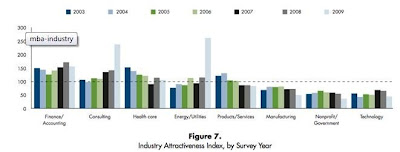
Susan Carey, chairwoman of Harvard's psychology department. "There was a lot of fat." Her department cut 15 percent of its own spending this year "almost without even noticing," she says.Arnold Kling
One way to quickly improve any university would be to eliminate the bottom 25 percent of teachers and replace them with online instruction from outside the university. Maybe online instructors cannot compete with high-quality in-person professors, but they can certainly replace the worst.Apparently we still need lots of MBA’s to go into finance.

Wednesday, December 09, 2009
Greenspun on Universites
by Andrew Gillen
I saw a couple of excerpts of a post by Philip Greenspun that lead me to believe it was going to be a rant about the ineffectiveness of lectures. As I’m a sucker for a good rant, I couldn’t resist, and while there is some ranting about lectures, it was quite interesting on a number of other topics as well.
Greenspun:
I saw a couple of excerpts of a post by Philip Greenspun that lead me to believe it was going to be a rant about the ineffectiveness of lectures. As I’m a sucker for a good rant, I couldn’t resist, and while there is some ranting about lectures, it was quite interesting on a number of other topics as well.
Greenspun:
candidates complained that private sector workers have not enjoyed increased real wages since the 1970s. Someone who had just finished read A Farewell to Alms would respond "If American workers aren't better educated than they were in the 1970s, why would you expect their wages to rise?"…
It made a lot of sense for professors to lecture in the 11th Century. What other means of broadcasting information from 1 person to 100 existed? Printing was very expensive and cumbersome. Having monks make 100 copies of a textbook by hand was not economically feasible…
Teaching technologies developed since 1088:
• movable type
• cheap paper made from trees
• telephone
• photocopier
• Web
How has this changed the way classes are conducted? We still have lectures and homework, just as in 1088. What other industry could survive without adopting at least some of the technologies of the last 1000 years into its core processes?...
In the face of massive technological advances, the most significant change that universities have made is removing their only quality control mechanism. Through tenure, the university now guarantees professors pay regardless of effectiveness…
One argument for traditional lecture-based teaching is that storytelling is a primal human activity… A problem with this approach is that it depends on finding millions of great storytellers…
[Mocks the lectures of one professor, quite unfairly in my opinion]
Bureau of Labor Statistics says that 1.7 million Americans work as college teachers (source). If Yale can't find teachers who can use classroom time effectively, what hope is there for universities with less money and prestige?...
Why should a university change? … There is literally no way that a university can be embarrassed by its graduates' poor overall performance…
[Suggestions for Change]
Stop grading your own students
Stop lecturing
Pedagogy researchers have found that people stop paying attention after about 20 minutes. That's as long as a lecture should be at a university…
Build open offices for students
Provide detailed review of all work; grade students on their ability to assist other students
The days in which the U.S. could get richer without getting smarter are over…
Links for 12/9/09
Bruce Bartlett
The median total time span from baccalaureate to doctorate among graduates was 9.4 years; median duration between starting and completing graduate school was 7.7 yearsConstantine Curris on presidential compensation
Peer comparisons have contributed to a pattern of marked increases in presidential salaries, the equivalent of a compensation arms race. No governing board wishes to be at the bottom of any list, much less a peer list. Across the higher-education spectrum, board members believe that, much like the children in Lake Wobegon, their leaders are "all above average," and the relentless pressure to be atop, or near the top, of the peer group results in an escalation in salary and benefits exceeding the most-liberal inflationary indexes.Mark Wilson, president and CEO of the Florida Chamber of Commerce
"Stop asking for money!"…SLA
Colleges can't just engage in their usual tack of asking business leaders to help them lobby legislators for more money, Wilson said; instead, they must show a propensity to "match up their supply of students with the demand for jobs.... I'm confident there will be more money available for degrees that the business community needs," but not necessarily more money for the status quo.
what it costs the government to originate a loan… $3.60Kevin Carey
a low-income student without a Pell grant in 1980 was better off than a low-income student with a Pell grant today.
How did that happen? Simple: college got much more expensive, overwhelming the many billions of dollars poured into the Pell grant program, and then some…
Yet people tend to treat this like some kind of inexorable naturally- occurring phenomenon, like boy bands or the phases of the moon, rather than a function of conscious choices by institutions and public policymakers, choices that could have been different in the past and should be different in the future…
Tuesday, December 08, 2009
Kudos to the University of Phoenix
The University of Phoenix should be commended for voluntarily releasing information on a range of issues. By doing so, they will be better positioned to survive once this type of disclosure becomes standard practice.
Links for 12/8/09
Todd Zywicki
Rob Reuteman
I note in passing that almost two years have now gone by since the loyalist slate was elected. Since that time, the trustees have never for a single moment ever suggested that they intend to back off from the board-packing plan, either publicly or privately. It was, to put the matter gently, an unorthodox negotiating tactic for the newly-elected members of the AoA Ex Comm to immediately surrender its only bargaining chip (the right to sue to enforce parity). This was a curious negotiating strategyTAMAR LEWIN
Less than two years after announcing that it would waive tuition for third-year students who pledge to spend five years working for nonprofit organizations or for the government, Harvard Law School is suspending the programTim Ranzetta on the debt swap proposal.
If projected budget impacts of this legislation were calculated using risk-adjusted discount rates, it would cost about $700 million over the 2010–2019 period—a difference of almost $10 billion relative to the estimated savings of $9.2 billionPeter Schmidt on the really strange goings on at NYU. Read it and count how many times you find yourself at a loss for words.
Rob Reuteman
Vocational educators cite many reasons for its current popularity: it’s far cheaper than four-year college; it usually takes two—not four –years of schooling; the quality of education has improved mightily; it fits easier into a work schedule because of the extensive use of online and distance learning ; and the resulting employment is viewed as being more secure.
“We are in a period in which students are focused on educational value, with a specific eye towards the applicability of academic programs.,” says Steven Roy Goodman
Monday, December 07, 2009
You Can't Have Cake and Eat it Too
by Daniel L. Bennett
Surely the temperature was warmer than the message delivered by Mark Wilson of the Florida Chamber of Commerce at last week's Higher Education Government Relation's Conference in Orlando: "Stop asking for money!"
Wilson was quoted by Inside Higher Ed as saying:
The idea that a state can attract businesses by increasing its pool of educated citizens is an unproven myth. Yet, it is precisely this fallacy that is often championed by higher education officials and their cheerleaders (see for example, efforts by Arizona and North Dakota) in lobbying for more public funds. A recent study released by CCAP and the ND Policy provides evidence to the contrary: that there is a negative relationship between public investments in higher education and economic growth.
While I'm sure that a skilled local workforce is appealing to prospective businesses, they are likely to consider a number of additional details when deciding where to locate, including the tax and regulatory conditions, local market / wage conditions, and access to distribution routes, among other things. The higher ed establishment favors tax hikes in order to increase the pool of funding available to it, which is counter intuitive to making a state or locale attractive to the businesses that will hopefully hire its graduates. If a state has an oversupply of college graduates but no employers to hire them, then they will migrate to places where jobs do exist. The higher ed establishment needs to learn that it can't have its cake and eat it too.
Surely the temperature was warmer than the message delivered by Mark Wilson of the Florida Chamber of Commerce at last week's Higher Education Government Relation's Conference in Orlando: "Stop asking for money!"
Wilson was quoted by Inside Higher Ed as saying:
Colleges can't just engage in their usual tack of asking business leaders to help them lobby legislators for more money...Wilson's statements are laudable in calling for accountability of higher ed and he continues with an equally compelling statement that:
they must show a propensity to "match up their supply of students with the demand for jobs.... I'm confident there will be more money available for degrees that the business community needs," but not necessarily more money for the status quo.
What the state needs in order to compete..is an education system that serves as a “talent supply chain” to produce enough educated and skilled workers to provide the workers needed by companies in Florida’s emerging industriesHowever, Wilson continues with somewhat of a dubious claim:
If Florida doesn’t produce them, the companies will leave to go where the workers are...I agree with Wilson that the education system should aim to produce graduates with the skills and education in demand by the labor force, but his assertion that companies will pack up shop and skip town if the local supply of workers is less than demand is questionable. Skilled workers are a highly mobile group, with a high propensity to follow the money trail. The high concentration of migratory skilled workers in the nation's most prosperous cities (New York, San Francisco, Washington, DC, etc) seems to suggest that educated workers go where the jobs are, not vice versa.
The idea that a state can attract businesses by increasing its pool of educated citizens is an unproven myth. Yet, it is precisely this fallacy that is often championed by higher education officials and their cheerleaders (see for example, efforts by Arizona and North Dakota) in lobbying for more public funds. A recent study released by CCAP and the ND Policy provides evidence to the contrary: that there is a negative relationship between public investments in higher education and economic growth.
While I'm sure that a skilled local workforce is appealing to prospective businesses, they are likely to consider a number of additional details when deciding where to locate, including the tax and regulatory conditions, local market / wage conditions, and access to distribution routes, among other things. The higher ed establishment favors tax hikes in order to increase the pool of funding available to it, which is counter intuitive to making a state or locale attractive to the businesses that will hopefully hire its graduates. If a state has an oversupply of college graduates but no employers to hire them, then they will migrate to places where jobs do exist. The higher ed establishment needs to learn that it can't have its cake and eat it too.
The Student Loan Battle Continues, Part 2
by Andrew Gillen
As I noted on Friday, the CBO has now estimated that the lenders alternative to SAFRA would save $75 billion dollars. This intensifies the battle over SAFRA, as there is now a plausible alternative for the Senate to rally around. I can’t tell if this is good news or bad news.
Much of the fighting taking place between SAFRA and the lender sanctioned alternative concerns which proposal will save more money. Neither of them is ideal on this count.
Thus, I don’t think the ideal policy of dropping SAPs (subsidies to lenders) and killing DL is achievable as a single step. That is why I’m rooting for a roundabout way to achieve it. The first step is to eliminate FFEL. That is why I am rooting for a pyrrhic victory for SAFRA as far as student loans are concerned. There are some other provisions of SAFRA that I’ve got some qualms about, but I hope they are successful in killing FFEL. As I outlined in this post, once FFEL is dead, the political landscape, the weaknesses of DL, and the cash flow issues of DL will begin to strongly favor the emergence of a private lending program, one that should avoid the problems inherent in FFEL.
As I noted on Friday, the CBO has now estimated that the lenders alternative to SAFRA would save $75 billion dollars. This intensifies the battle over SAFRA, as there is now a plausible alternative for the Senate to rally around. I can’t tell if this is good news or bad news.
Much of the fighting taking place between SAFRA and the lender sanctioned alternative concerns which proposal will save more money. Neither of them is ideal on this count.
if the motivation of dropping the FFEL is to save money, than that is the wrong policy. To save even more money, drop the SAPs (payments to lenders) for FFEL and abolish DL.What are the prospects for doing this? Not good. To begin with, none of the bills in play advocate this. In addition, looking at the bigger picture of finances in general, I’ve been horrified by the financial community’s ability to stave off needed reforms, especially as it relates to moral hazard. While I think that the Obama administration made a strategic mistake by not addressing this before moving on to other issues such as health care, there is something highly disturbing about the effectiveness of their resistance. If we can’t get serious reform in the aftermath of the worst financial crisis in 80 years without the undivided attention of the President, that doesn’t bode well for ever fixing the problems with FFEL. When combined with the lobbying by the lenders using such high powered Democrats such as Jamie Gorelick and Tony Podesta, I think the prospects for turning FFEL into a rational program in the absence of the current crisis are very small.
Thus, I don’t think the ideal policy of dropping SAPs (subsidies to lenders) and killing DL is achievable as a single step. That is why I’m rooting for a roundabout way to achieve it. The first step is to eliminate FFEL. That is why I am rooting for a pyrrhic victory for SAFRA as far as student loans are concerned. There are some other provisions of SAFRA that I’ve got some qualms about, but I hope they are successful in killing FFEL. As I outlined in this post, once FFEL is dead, the political landscape, the weaknesses of DL, and the cash flow issues of DL will begin to strongly favor the emergence of a private lending program, one that should avoid the problems inherent in FFEL.
Links for 12/7/09
DiscoverScholars.org
John Leo

the more money a school has, the less likely it is to use that dollar productively. It follows, then, that underfunded schools could actually do more good with the money that’s being heaped upon schools with large endowments…Scott Carlson reports that a New York court has blocked Columbia’s attempted land grab through the governments powers of eminent domain. My previous post on this is here.
donations to schools with less funding are probably more productive than donations to rich schools, donating to any school is still inefficient, and helps to push tuition costs higher. To maximize a donation’s impact on higher education, donors are better advised to give directly to students (who have no endowments) instead of to schools.
John Leo
The [American Anthropological Association] censured Chagnon, an astounding act by a professional academic group. To the amazement to many, myself included, the association later revoked the censure and did it with unusually blunt language: "The task force compromised its objectivity by merging its investigation with a political agenda, in that its mission in conducting the investigation was intended to challenge 'Western elites,' and 'interrupt regimes of knowledge and power."IPEDS compliance (HT: BM)

Friday, December 04, 2009
The Student Loan Battle Continues, Part 1
by Andrew Gillen
In response to the CBO analysis showing the alternative to SAFRA would save $75 billion, Chairman George Miller (D) attacked the scoring, stating that
One of the budget gimmicks that Miller correctly notes is that
Moreover, recall the Democratic response to a gimmick concerning administrative costs:
In response to the CBO analysis showing the alternative to SAFRA would save $75 billion, Chairman George Miller (D) attacked the scoring, stating that
“You can dress this up 100 different ways and put a Santa Hat on it, but this is still the same budget gimmick.”Ranking Republican John Kline retorted that
“It’s clear that Democrats didn’t like the truth… so they shamelessly decided to have a little fun with the numbers.”Oh, whoops, that wasn’t Kline on criticism of the CBO scoring of the alternative bill, it was Chairman Miller on criticism of the CBO scoring of SAFRA (just replace “Democrats” with “Republicans”).
One of the budget gimmicks that Miller correctly notes is that
Most of the savings the Sallie Mae plan generates are achieved through the gimmick of sunsetting the proposal after five years.This is certainly very gimmicky. Unfortunately, people don’t seem to mind gimmicks when they work in their favor. Consider a sunsetting of a provision of the College Cost Reduction Act that influences SAFRA’s score. Currently, the interest rate on subsidized loans for undergraduates is scheduled to increase from 3.4% to 6.8% in 2012-2013. Are we really to believe that Congress is going to let the interest rate double in three years time? The chances of that happening are slim to none, but that’s what the current law says, so that’s what the CBO scores it as. This is a source of significant revenue for SAFRA that will not materialize, so this certainly qualifies as a gimmick on par with the lenders sunsetting provisions.
Moreover, recall the Democratic response to a gimmick concerning administrative costs:
they were replying to a letter that very explicitly noted that the 86.8 figure included 7b in savings from eliminating FFEL administrative costs, but not the 7.2b in additional administrative costs for DL. That they are aware of this and still insist on using the 90b figure is Enronesque.Sadly, these are just more examples of the inappropriate use of CBO’s analysis. As Free Exchange noted
Ideally, the parties would approach each piece of analysis produced by the CBO as being informative but recognizing potential shortcomings. Instead, the side helped by a release trumpets it as unassailable and the side harmed by it says that this time the CBO blew it. So instead of having profitable debates about an agreed upon set of imperfect figures, we get unhelpful chaos.
Thursday, December 03, 2009
Follow the Loser
by Daniel L. Bennett
Last week, I wrote about Northeastern's University's decision to eliminate its football program. Fellow Colonial Athletic Association member, Hofstra University, today announced that it will follow in NU's footsteps by ending its football program. The Chronicle of Higher Education reports that Hofstra's average attendance to football games was 500 this past season and it sold a whopping 172 season tickets. The move will save the University $4.5 million annually. A letter for President Stuart Rabinowitz described the decision:
Last week, I wrote about Northeastern's University's decision to eliminate its football program. Fellow Colonial Athletic Association member, Hofstra University, today announced that it will follow in NU's footsteps by ending its football program. The Chronicle of Higher Education reports that Hofstra's average attendance to football games was 500 this past season and it sold a whopping 172 season tickets. The move will save the University $4.5 million annually. A letter for President Stuart Rabinowitz described the decision:
we could not continue to justify the expense of football compared to the benefits it brought to the University
This strategic decision to reallocate resources is based on our academic mission and priorities, and our vision of attaining recognition as one of our nation’s leading universities. Investment in academic initiatives and need-based scholarships is warranted for the long term benefit of our students and the University community.
Links for 12/3/09
KC Johnson on how Minnesota
worries about people who exhibit a "denial of difference"---which is characterized by an "affective quality" that is "benign on the surface ('live and let live'), but potentially genocidal (!!) when pressed into cross-cultural contact." Such libertarian beliefs, the IDI report hilariously observes, might indicate "possible support for supremacist and hate groups."Jack Stripling
Or there's the person determined to minimize difference---with "recognition and acceptance of superficial cultural differences such as eating customs, etc., while holding that all human beings are essentially the same." The "affective quality" of such people? "Insistently nice." (A new motto: "Come to the U of M: We produce mean teachers!") These inherently nice people, the IDI overview warns, are inclined toward "acceptance of institutionalized privilege"--- a definite no-no in any Education program.
In an effort to boost tuition revenues, a State University of New York campus lowered admissions and retention standards to admit unqualified – predominately black – applicants who had little chance of graduating, according to a lawsuit filed by a former dean.Andrew Samwick describes our last stimulus as
Thomas J. Hickey, who filed the suit, says his removal as dean in July was retaliation for questioning financially-motivated academic policies that doomed students to failure…
Thomas Cronin, a physics professor… “The list of academically and morally corrupt practices that ensue from our inability to adhere to our own standards is rather long,” he wrote. “One of our worst offenses is that we admit, and re-admit students absolutely unqualified and absolutely incapable of achieving a college degree. Many go into debt or cause their families to go into debt into [sic] order to attempt a college degree. This is an absolutely corrupt practice and it may be criminal.
firing money out of a cannon while blindfolded (a.k.a. timely, targeted, and temporary)...
So what should our elected officials do about it today? Two things. First, begin to implement long-term infrastructure investments … Second, apologize for waiting two years and wasting hundreds of billions of dollars on the wrong ideas before getting around to doing what has been needed all along.
Wednesday, December 02, 2009
Taking Profit Out of For-Profit Education
by Daniel L. Bennett
The Department of Education recently released details of its negotiated rule-making for higher education panel that includes proposed legislative changes. The 100+ page document contains several proposals aimed to reduce "improprieties" (could be read as competitiveness) of the for-profit higher ed sector. Central to these is proposed legislation to eliminate the 12 so-called safe harbors for incentive-based compensation. Rather than pragmatically examining the effects of each individual "safe harbor" in order to come to a reasoned conclusion about the consequences of each, the ED aims to strike all 12 exceptions to incentive-based compensation.
I concede that some for-profit schools employ overly aggressive recruiting tactics that is likely a result of a performance-based culture that is not present in the public and not-for-profit sectors. However, career colleges are engrossed in serious competition for students, and the ability to enroll them is critical to the survival of such schools due to the reliance on tuition and absence of direct public subsidies, mammoth endowments and research funding. This means that institutions driven by the profit motive must meet enrollment objectives to remain financially viable, and the market-based nature of the for-profit business model suggests that incentivizing the employees charged with filling seats is the most productive method of achieving these goals and remaining competitive.
Now, here comes the ED with an attempt to eliminate incentive-based compensation and thus, reduce the competitiveness of the entire for-profit sector. The proposed legislative changes are the ED's starting position for negotiation and likely will be significantly watered down by the time any such legislative change is effected. The for-profit sector will likely wage war against these changes. Of particular concern should be the ED's proposal to strike down safe harbors:
The Department of Education recently released details of its negotiated rule-making for higher education panel that includes proposed legislative changes. The 100+ page document contains several proposals aimed to reduce "improprieties" (could be read as competitiveness) of the for-profit higher ed sector. Central to these is proposed legislation to eliminate the 12 so-called safe harbors for incentive-based compensation. Rather than pragmatically examining the effects of each individual "safe harbor" in order to come to a reasoned conclusion about the consequences of each, the ED aims to strike all 12 exceptions to incentive-based compensation.
I concede that some for-profit schools employ overly aggressive recruiting tactics that is likely a result of a performance-based culture that is not present in the public and not-for-profit sectors. However, career colleges are engrossed in serious competition for students, and the ability to enroll them is critical to the survival of such schools due to the reliance on tuition and absence of direct public subsidies, mammoth endowments and research funding. This means that institutions driven by the profit motive must meet enrollment objectives to remain financially viable, and the market-based nature of the for-profit business model suggests that incentivizing the employees charged with filling seats is the most productive method of achieving these goals and remaining competitive.
Now, here comes the ED with an attempt to eliminate incentive-based compensation and thus, reduce the competitiveness of the entire for-profit sector. The proposed legislative changes are the ED's starting position for negotiation and likely will be significantly watered down by the time any such legislative change is effected. The for-profit sector will likely wage war against these changes. Of particular concern should be the ED's proposal to strike down safe harbors:
(2) Enrollment in programs that are not eligible for title IV, HEA program funds.Eliminating this exception would be an intrusion of the federal government into territory that it has no direct interest. The only federal funds that for-profit institutions garner is that provided by title IV funding, or federal student aid. Students enrolled in programs not eligible for federal aid fund the education by private means, perhaps with the aid of local or state retraining programs. In the latter case, such legislation to restrict incentive compensation should be left to the respective states whose funds are expended, rather than a top-down command from the federal level.
An institution may provide incentive compensation to recruiters based upon their recruitment of students who enroll only in programs that are not eligible for title IV, HEA program funds.
(4) Profit-sharing bonus plans.Profit margins in higher education are strongly related to enrollment figures. This means that recruiting plays a significant role in the profitability (hence, viability and competitiveness) of an institution. The market system relies on incentives to boost productivity. One of the most common incentive instruments is profit-sharing or bonuses. Eliminating a private companies ability to incentivize its employees would be a critical blow to its level of productivity. Organizations that don't offer compensation incentives (e.g. government) are plagued by low levels of employee productivity.
Profit-sharing and bonus payments to all or substantially all of an institution's full-time employees are not incentive payments based on success in securing enrollments or awarding financial aid. As long as the profit-sharing or bonus payments are substantially the same amount or the same percentage of salary or wages, and as long as the payments are made to all or substantially all of the institution‟s full-time professional and administrative staff, compensation paid as part of a profit-sharing or bonus plan is not considered a violation of the incentive payment prohibition. In addition, such payments can be limited to all or substantially all of the full-time employees at one or more organizational levels at the institution, except that an organizational level may not consist predominantly of recruiters, the admissions staff, or the financial aid staff.
(9)Profit distributions.If profit distributions to owners are restricted, then investors will tuck their tails and head for the hills. This will essentially eliminate the entire sector, as for-profit institutions would squander away all of their excess revenues in a manner similar to the public and non-profit private sectors. If this were to occur, then for-profits would converge to the status quo non-profit model of higher education, and squelch the opportunity for much-needed innovation and transformation that is being tested in the for-profit sector.
Profit distributions to owners are not payments based on success in securing enrollments or awarding financial aid. Therefore any owner, whether an employee or not, is entitled to a share of the organization‟s profits to the extent they represent a proportionate share of the profits based upon the employee‟s ownership interest.
Subscribe to:
Posts (Atom)

